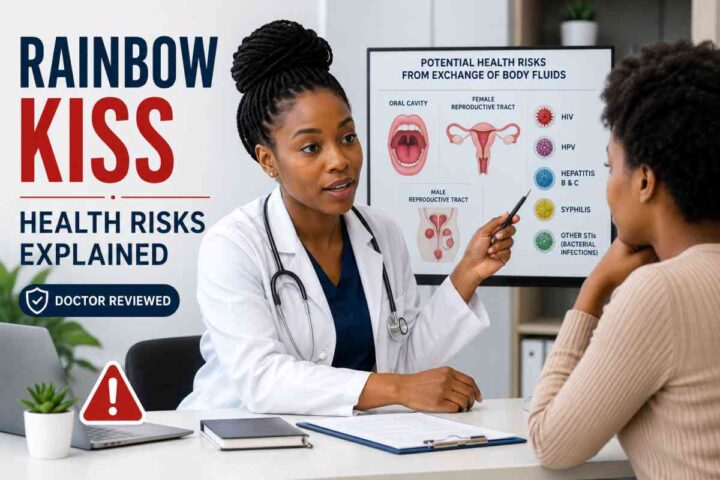
Despite its name, the rainbow kiss is not associated with colourful makeup, lipstick, candy, or the rainbow flag of the LGBTQ+ community. It is a sexual act involving the exchange of menstrual blood and semen between partners, usually through oral sex, followed by kissing. “Rainbow kiss” has become an accepted sexual slang term for this practice.
The practice is not risk-free because it can involve exposure to blood, semen, and genital tissues, which may carry sexually transmitted infections (STIs). However, the risk level depends on factors such as the partner’s infection status, the presence of genital cuts or sores, and whether protective barriers are used.
This article explains what a rainbow kiss is, why it is called that name, and how the term became popular. You will also see the possible health risks of the practice and safety precautions that may reduce exposure to sexually transmitted infections.
“Rainbow kiss” means a sexual practice involving menstrual blood and semen, generally through oral sex followed by kissing. The term is not connected to the rainbow flag or any particular sexual orientation.
Because it may involve contact with blood and bodily fluids, it potentially carries a risk for blood-borne infections.
What is a Rainbow Kiss?

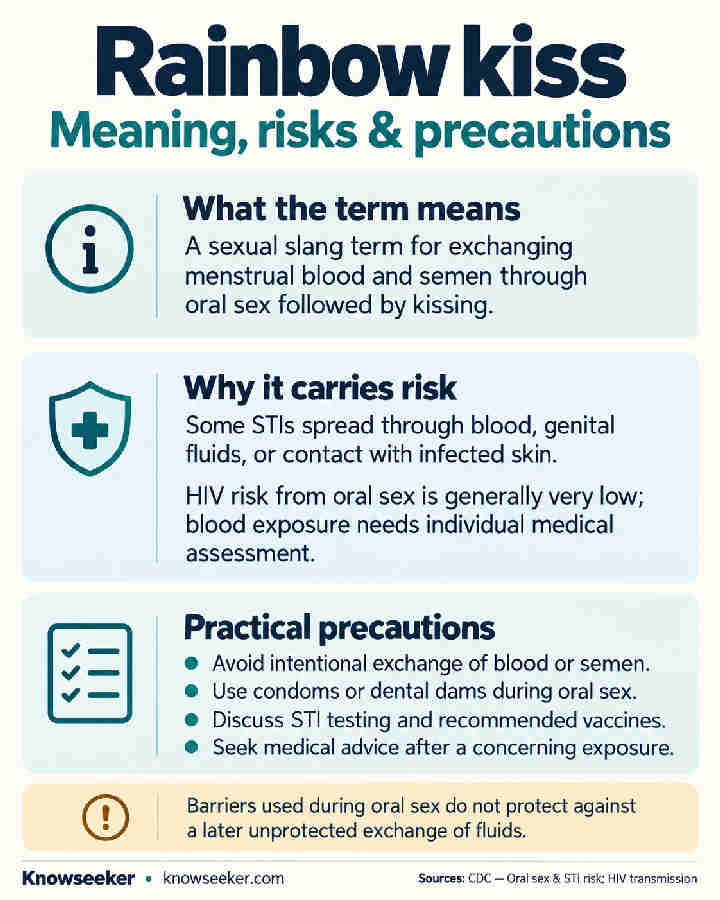
A rainbow kiss is a sexual slang term used to describe the exchange of menstrual blood and semen through oral sexual activity and kissing. The term “rainbow kiss” is used figuratively to refer to the mixing of the two fluids in the mouth after oral sexual activity. Thus, it describes a sexual practice rather than a specific type of romantic kiss.
The term is often talked about, particularly on the internet, due to the shocking nature of its meaning. Due to this, it has gained significant popularity on social media, particularly TikTok, driven by curiosity and people’s attempts to drive engagement through shock and disgust.
Lastly, the rainbow kiss also raises questions about how it occurs, whether it exists in reality, and concerns about its health and safety implications.
How Does a Rainbow Kiss Occur?
A rainbow kiss is generally said to occur when partners perform oral sex during menstruation and then share a kiss, resulting in the mixing of menstrual blood and semen. The term may be used to describe any intentional oral contact involving these body fluids.
A rainbow kiss should not be confused with an ordinary kiss or period sex alone. This is because it typically involves the exchange of both menstrual blood and semen during the kiss, thus exposing the mouth and mucous membranes to blood and genital fluids, potentially transmitting certain infections.
Although the term has existed for some time, social media, especially TikTok, helped boost its popularity. However, its popularity on the internet does not indicate how commonly the sexual practice occurs.
Why Is It Called a Rainbow Kiss?
The rainbow kiss is thought to describe what the act’s result could look like. This idea may have informed the choice of the name “Rainbow kiss“, as though involving more than one color or shades of different colors. However, little is known about its origin, who invented it, and why it was named as such.
“Rainbow kiss” gets most of its attention from social media, particularly TikTok, due to the reactions it evokes. But these discussions frequently use the phrase without explaining it directly, making it difficult to understand its true origins or why exactly it was named as such.
Is a Rainbow Kiss Safe?
A rainbow kiss can expose partners to infections, but the transmission route and likelihood depend on the infection and the circumstances. Sexual contact with infected menstrual blood and semen can transmit sexually transmitted infections like HIV, Hepatitis, and oral bacterial infections. HPV primarily can spread through sexual contact with infected skin or mucosal surfaces.1Centers for Disease Control and Prevention. (2025, January 31). About genital HPV infection. https://www.cdc.gov/sti/about/about-genital-hpv-infection.html
A rainbow kiss isn’t risk-free, but the risk depends on the infection and the circumstances of exposure. For example, gonorrhoea and chlamydia can infect the mouth and throat following contact with infected genitals; syphilis can spread through direct contact with an infectious sore, while Herpes and HPV can spread even when there are no visible sores or symptoms.2Centers for Disease Control and Prevention. (2024, February 6). About STI risk and oral sex. https://www.cdc.gov/sti/about/about-sti-risk-and-oral-sex.html
The circumstances of exposure could include whether a partner has a transmissible infection, the presence of sores or bleeding, or whether a barrier such as a condom or dental dam is used. Absence of symptoms does not exclude an infection; thus, barrier protection is advised during a rainbow kiss.
Health Risks of a Rainbow Kiss
The main health risks of a rainbow kiss come from the exchange of menstrual blood and semen. These are potentially infectious if a partner has an STI.
Compared to vaginal intercourse, it is not known whether a rainbow kiss carries a greater overall infection. This is because the practice has not been studied directly, but here are some of the most important health risks of a rainbow kiss.
1. HIV
According to the CDC, HIV transmission through oral sex is extremely unlikely, much less likely than transmission through anal or vaginal sex. However, infected blood or semen can transmit the virus when it contacts mucous membranes or damaged tissue. This may apply to the rainbow kiss, even though it does not mean that HIV infection is likely after every exposure during the act.
2. Hepatitis B and C
Hepatitis B and C are caused by different viruses that infect the liver. Hepatitis B can be transmitted when infected blood, semen, or other body fluids enter another person’s body. Hepatitis C primarily spreads through exposure to infected blood. Both scenarios can be encountered during a rainbow kiss.
Vaccination against hepatitis B provides protection, but there is currently no available vaccine for hepatitis C.
3. Gonorrhea and Chlamydia
These are bacterial infections of the genital tract but can infect the throat, rectum, and eyes. Gonorrhea is caused by the bacterium Neisseria gonorrhoeae and can infect the throat, genitals, rectum, and eyes. Chlamydia is caused by Chlamydia trachomatis.
These infections can cause genital infections in men with severe urinary symptoms, sepsis, and infertility, especially when untreated. In women, they can cause pelvic inflammatory disease, sepsis, and infertility. In addition, these two organisms have been associated with cases of severe conjunctivitis or Apollo eye infection.
4. Syphilis
Syphilis is caused by the bacterium Treponema pallidum and causes disfiguring sores around the mouth and genitals. It can be transmitted during a rainbow kiss when one partner has active syphilitic sores in or around the mouth or genitals. Untreated, syphilis can lead to serious complications involving the heart and nervous system.
5. Genital herpes
Herpes is caused by the herpes simplex virus. There are two subtypes: HSV-1 and HSV-2. These are transmitted during contact with someone with an active oral or genital herpes infection. Herpes lesions could cause pain or burning sensation around the area of the sore.
6. Human Papillomavirus
Human Papillomavirus (HPV) is another virus that can be transmitted via a rainbow kiss. It infects the skin and mucous membranes around the mouth and genitals, and it causes genital warts, oropharyngeal and cervical cancers.3Faneye AO, Babalola OS, Odaibo GN, Arotiba J, Olaleye OD. Oral human papillomavirus infection among dental clinic attendees in Ibadan, Nigeria. Afr J Lab Med. 2022 Nov 25;11(1):1555. doi: 10.4102/ajlm.v11i1.1555. PMID: 36483321; PMCID: PMC9724044.4Centers for Disease Control and Prevention. (2024, September 17). HPV and oropharyngeal cancer. U.S. Department of Health and Human Services. https://www.cdc.gov/cancer/hpv/oropharyngeal-cancer.html
Several strains of HPV are classified into low-risk and high-risk subtypes. While the low-risk subtypes cause genital warts, the high-risk subtypes can evade the body’s immune system and cause cervical cancer.5National Cancer Institute. (n.d.). HPV and cancer. U.S. Department of Health and Human Services. Retrieved July 15, 2026, from https://www.cancer.gov/about-cancer/causes-prevention/risk/infectious-agents/hpv-and-cancer6Huber J, Mueller A, Sailer M, Regidor PA. Human papillomavirus persistence or clearance after infection in reproductive age. What is the status? Review of the literature and new data of a vaginal gel containing silicon dioxide, citric acid, and selenite. Women’s Health (Lond). 2021 Jan-Dec;17:17455065211020702. doi: 10.1177/17455065211020702. PMID: 34096424; PMCID: PMC8785287.
| Infection | Relevant transmission route |
|---|---|
| HIV | HIV transmission through oral sex is generally extremely unlikely. Exposure to infected blood or semen through mucous membranes or damaged tissue requires individual assessment of risk. |
| Hepatitis B | Infected blood, semen, and certain other body fluids; vaccination provides important protection |
| Hepatitis C | Primarily blood-to-blood exposure; sexual transmission is less common |
| Gonorrhoea and chlamydia | From genital secretions; can infect the throat or genitals through oral sexual contact |
| Herpes and syphilis | Primarily contact with infected skin, sores, or lesions |
| HPV | Skin-to-skin or mucosal sexual contact rather than simply exchanging fluids |
How To Reduce the Risks?
A rainbow kiss carries some risks of the above infections. As mentioned earlier, the health risk is higher when there is/are:
- A current or undiagnosed STI
- Mouth ulcers, cuts, or bleeding gums
- Genital sores or bruises
- Direct exposure to blood
- Lack of barrier protection during the act
- Lack of hepatitis B or HPV vaccination
- A new partner without recent STI testing
To reduce the health risks associated with a rainbow kiss, the following are recommended;
- Regular testing: According to the CDC, regular testing and sharing results with your partner are important ways to prevent STIs from any form of unprotected sex, including rainbow kiss. “Regular STI testing and open communication with your partner are the two most important steps before engaging in any activity involving blood or bodily fluids,” notes Dr. Prosper Yole.
- Open communication: Before engaging in a sexual activity with a new partner, obtain consent and be open to discussing past partners, history of STIs, and drug use before getting involved.
- Barrier protection: Barrier protection, such as condoms and oral dams, can help prevent infections via a rainbow kiss by preventing/minimizing contact. However, barriers used during oral sex cannot prevent infection if the fluids are intentionally exchanged without the barrier afterwards.
- Having a faithful partner: Being in a mutually monogamous relationship with a sexual partner who has been tested and does not have an STI helps minimize the risks.
- HPV and Hepatitis B vaccination: HPV vaccination helps prevent new infection but does not treat an already existing infection. Hepatitis B vaccination provides protection. After a possible exposure, a clinician may recommend vaccination, sometimes together with hepatitis B immunoglobulin.7Haber, P., & Schillie, S. (2024, May 9). Chapter 10: Hepatitis B. Centers for Disease Control and Prevention. https://www.cdc.gov/pinkbook/hcp/table-of-contents/chapter-10-hepatitis-b.html
What Should You Do After a Possible Exposure?
After unprotected exposure to blood or genital secretions during oral sex, here are some post-exposure actions to take.
- Contact a healthcare professional or sexual-health clinic immediately.
- Do STI testing at intervals recommended by your clinician.
- Check hepatitis B vaccination status through tests recommended by the clinician.
- Avoid unproven home remedies or disinfectants.
- Seek urgent medical assessment after a possible HIV exposure. A clinician can determine whether post-exposure prophylaxis (PEP) is indicated. When indicated, it should begin as soon as possible, ideally within 24 hours and no later than 72 hours after exposure.
Is Rainbow Kiss a Common Practice?
Some consenting adults may regard it as a sexual preference or fetish. The concept has been primarily a topic of online discussion, but online discussion and search interest do not establish how commonly people practise a rainbow kiss. However, a lack of reliable prevalence data does not directly mean nobody does it.
Partners may view the practice as an expression of trust and vulnerability. As with every other intimate sexual activity, trust and consent remain important. However, a mutual acceptance of exchanging intimate bodily fluids does not mean the practice is common or medically safe.
Precautions need to be put in place before carrying out a practice such as the rainbow kiss.
Frequently Asked Questions
Is a rainbow kiss a real sexual practice?
“Rainbow kiss” is a slang term describing a particular sexual behaviour. Online discussion does not establish how commonly people practise it. A lack of reliable prevalence data is not proof that nobody does it.
Is a rainbow kiss common?
There is currently insufficient reliable data to show whether the rainbow kiss is commonly practiced. Much of the attention it receives comes from social media posts, online discussions, and curiosity-driven searches rather than actual population studies.
Is a rainbow kiss connected to LGBTQ+ identity?
Despite the "rainbow" in the name, the rainbow kiss has no connection to LGBTQ+ identity or pride symbolism. It's an unrelated internet slang term used to describe oral sex involving the exchange of menstrual blood and semen.
What Does Rainbow Kiss Mean on TikTok?
On TikTok, “rainbow kiss” refers to the same practice involving the exchange of menstrual blood and semen. It does not have a TikTok-specific meaning.
Final words
A rainbow kiss can involve exposure to blood, genital fluids, and infected skin or mucosal surfaces, thus carrying a risk of transmitting infections. This risk depends on the circumstances of exposure and the type of infection. Understanding these various transmission routes and safety precautions can help people make informed sexual health decisions.
If you’re curious about sexual health topics or want medically accurate answers to common health questions, explore our other evidence-based guides. Getting accurate information is one of the best ways to protect your health and make better health decisions.
References
| ↑1 | Centers for Disease Control and Prevention. (2025, January 31). About genital HPV infection. https://www.cdc.gov/sti/about/about-genital-hpv-infection.html |
|---|---|
| ↑2 | Centers for Disease Control and Prevention. (2024, February 6). About STI risk and oral sex. https://www.cdc.gov/sti/about/about-sti-risk-and-oral-sex.html |
| ↑3 | Faneye AO, Babalola OS, Odaibo GN, Arotiba J, Olaleye OD. Oral human papillomavirus infection among dental clinic attendees in Ibadan, Nigeria. Afr J Lab Med. 2022 Nov 25;11(1):1555. doi: 10.4102/ajlm.v11i1.1555. PMID: 36483321; PMCID: PMC9724044. |
| ↑4 | Centers for Disease Control and Prevention. (2024, September 17). HPV and oropharyngeal cancer. U.S. Department of Health and Human Services. https://www.cdc.gov/cancer/hpv/oropharyngeal-cancer.html |
| ↑5 | National Cancer Institute. (n.d.). HPV and cancer. U.S. Department of Health and Human Services. Retrieved July 15, 2026, from https://www.cancer.gov/about-cancer/causes-prevention/risk/infectious-agents/hpv-and-cancer |
| ↑6 | Huber J, Mueller A, Sailer M, Regidor PA. Human papillomavirus persistence or clearance after infection in reproductive age. What is the status? Review of the literature and new data of a vaginal gel containing silicon dioxide, citric acid, and selenite. Women’s Health (Lond). 2021 Jan-Dec;17:17455065211020702. doi: 10.1177/17455065211020702. PMID: 34096424; PMCID: PMC8785287. |
| ↑7 | Haber, P., & Schillie, S. (2024, May 9). Chapter 10: Hepatitis B. Centers for Disease Control and Prevention. https://www.cdc.gov/pinkbook/hcp/table-of-contents/chapter-10-hepatitis-b.html |













You Might Also Like