

The four temperaments are sanguine, choleric, melancholic, and phlegmatic. They derive from a traditional classification system that describes four human personality types based on our natural emotional tendencies, behavioural patterns, and how people respond to their environment.
The four temperament model originated in ancient Greek medicine from the four humors theory. This theory proposed that human health and behaviour were influenced by the balance of the four bodily fluids: blood, yellow bile, black bile, and phlegm. Here, sanguine (from blood) is described as outgoing and enthusiastic, choleric (yellow bile) is decisive and driven, melancholic is thoughtful and detail-oriented, while phlegmatic is calm and patient.
In this article, we’ll see the traits, strengths, and weaknesses of each of the four temperaments and how they might show up in everyday life.
| Temperament | Common traits | Strength | Potential weakness |
|---|---|---|---|
| Sanguine | Outgoing, expressive, enthusiastic | Connects easily with people | May lose focus or struggle to follow through |
| Choleric | Assertive, decisive, goal-oriented | Takes initiative and makes decisions quickly | May become impatient with others |
| Melancholic | Reflective, analytical, detail-oriented | Plans carefully and spots problems early | May overthink decisions |
| Phlegmatic | Calm, patient, easygoing | Listens well and helps ease tension | May avoid difficult conversations |
Introduction to the traits, strengths, and weaknesses of the four temperaments.
The Four Temperament Types Defined
The four temperament characteristics take origin from Hippocrates’ four temperament theory, which proposes that the predominant fluid/humor in the body can influence our behavior.
According to Hippocrates, excess blood leads to the sanguine temperament and makes people more lively, warm, and energetic. Excess phlegm produces the phlegmatic temperament and causes a sluggish and calm demeanour. People with excess yellow bile are choleric and are more excitable and aggressive, while excess black bile was used to describe the melancholic temperament, which is more despondent and depressed.
The following chart summarizes the major characteristics of the four temperament types and which ones are extroverted and introverted.
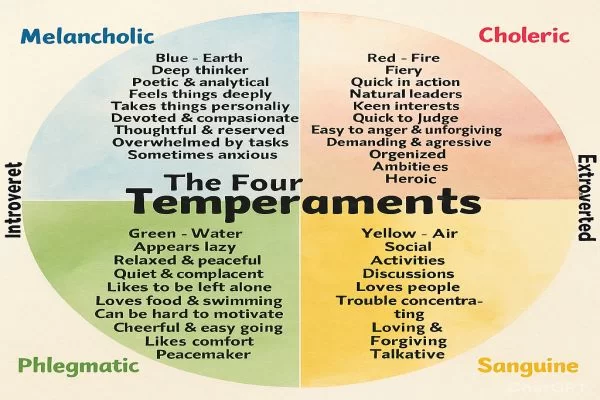
Characteristics, Strengths and Weaknesses of the Four Temperaments
Without further ado, let’s see the four temperaments in detail, their characteristics, strengths, and weaknesses.
1. Sanguine: Traits, Strengths & Weaknesses
In the traditional four-temperament model, the sanguine is described as outgoing, expressive, and optimistic. They enjoy being around people, start conversations easily, and build relationships quickly. Even when they join a conversation midway, their enthusiasm can draw others in.
Sanguines often have a knack for storytelling. They use humor, gestures, and vivid details to turn an ordinary experience into an entertaining story. Their enthusiasm can also lift a group’s mood, especially when others are hesitant to join.
That enthusiasm can make it easy to get carried away. A sanguine might get so involved in a conversation that they lose track of time, or start a new project with excitement and lose interest once the work becomes repetitive. They may also express frustration openly but bounce back quickly.
Strengths of the Sanguine
- Warm and approachable. They tend to put people at ease and build rapport quickly.
- Expressive communicators. They tell engaging stories and share ideas in ways that hold people’s attention.
- Optimistic and encouraging. They often see possibilities when others feel discouraged and help lift the group’s mood.
- Adaptable in social situations. They can strike up conversations and find common ground in unfamiliar groups.
Potential Weaknesses of the Sanguine
- Inconsistent follow-through. They may start enthusiastically and struggle to stay focused when a task becomes routine.
- Impulsiveness. They may say yes to plans or take on commitments before thinking through the details.
- Poor time management. They can get absorbed in the moment and lose track of time or overlook commitments.
- Exaggeration. In the excitement of telling a story, they may embellish details for effect.
2. Choleric: Traits, Strengths & Weaknesses
In the four-temperament model, the choleric is described as assertive, independent, and result-focused. Cholerics tend to communicate directly, make decisions quickly, and take the lead when a group needs direction.
They often enjoy a challenge and look for another way forward when a plan stalls. In a group project with a tight deadline, a choleric might work out what needs to happen first, divide up the work, and help the team get moving. If a task falls behind, they may adjust the plan quickly. That decisiveness can be especially helpful when everyone is waiting for someone to make the call.
Their sense of urgency can also make them impatient with people who need more time to think or discuss a decision. When focused on getting things done, a choleric may push ahead before everyone has a chance to raise concerns. Their directness can come across as abrupt, especially under pressure.
Strengths of the Choleric
- Decisive. They make choices quickly and give others a clear sense of what to do next.
- Practical. They turn broad goals into specific steps and focus on what will move the work forward.
- Persistent. When they hit a setback, they look for another way to reach the goal.
- Willing to take initiative. They’re comfortable taking responsibility and tackling problems others may hesitate to address.
Potential Weaknesses of the Choleric
- Impatience. They may become frustrated when progress is slow or a decision takes longer than they expect.
- Overly controlling. They may take over tasks that others could handle or insist on doing things their way.
- Blunt communication. They may deliver feedback so directly that it comes across as harsh.
- Resistance to feedback. Once they’ve settled on a plan, they may dismiss useful objections too quickly.
3. Melancholic: Traits, Strengths & Weaknesses
In the traditional four-temperament model, the melancholic is described as reflective, analytical, and detail-oriented. Melancholics are described as perfectionistic and tend to care about doing things perfectly well.
Melancholics tend to take their responsibilities seriously and often ask specific questions. They critically analyze new information before accepting it, often holding on to old beliefs longer than others would.
Due to their strong attention to detail, a melancholic might be the one to notice easy-to-find conflict in a group’s plan, such as assigning the same role to the same group member for the same schedule. This analytical mindset can make it hard to settle on a decision or call a task finished. They spend extra time refining details even when they make little difference to the outcome.
When something goes wrong, they may dwell too long on what they could have done differently. They may hold a grudge for a long time because they believe that someone who hurts them can hurt them again.
Strengths of the Melancholic
- Analytical. They ask thoughtful questions and examine the details before concluding.
- Organised. They plan ahead, keep track of responsibilities, and anticipate what others might overlook.
- Conscientious. They take commitments seriously and put care into the work they deliver.
- Attentive to others. They may remember small details that matter to someone and follow up when that person is going through a difficult time.
Potential Weaknesses of the Melancholic
- Perfectionism. They may spend more time than a task requires trying to meet their own standards.
- Overthinking. They can delay decisions by continuing to compare options even after they have enough information to decide.
- Excessive caution. They may focus so much on what could go wrong that they hesitate to try a workable idea.
- Self-criticism. They may take feedback to heart or dwell on mistakes long after they’ve corrected them.
4. Phlegmatic: Traits, Strengths & Weaknesses
In the traditional four-temperament model, the phlegmatic is described as calm, patient, and cooperative. Phlegmatics can be described as reserved, often preferring familiar routines and the company of a few close friends. They may also need time to adjust when plans change suddenly.
Phlegmatics are loyal to a few friends. They find it hard to break an existing friendship irrespective of what the other person does, but once a relationship is broken, they seldom return.
When working with people, phlegmatics often take a passive reconciliatory position. They tend to contribute quietly through listening, offering practical help, and following through on commitments, rather than taking active leadership roles.
When two teammates disagree, a phlegmatic might hear both sides and suggest a compromise. That same desire to maintain peace can make it hard to speak up even if they have reservations.
Strengths of the Phlegmatic
- Calm under pressure. They tend to stay composed when plans go wrong, or tensions rise.
- Patient listeners. They give people time to explain themselves before responding.
- Diplomatic. They look for common ground and can help people resolve disagreements.
- Dependable. They show up for people and follow through on commitments.
Potential Weaknesses of the Phlegmatic
- Avoids confrontation. They may avoid a difficult conversation until the issue becomes harder to resolve.
- Hesitates to make decisions. They may wait for someone else to choose, especially when people disagree.
- Takes time to adjust to change. Sudden changes can be harder to accommodate when they’ve settled into a routine.
- Struggles to say no. They may agree to something they’re uncomfortable with to avoid disappointing someone.
Now that you’ve explored all four temperament types, take the free temperament test to see how strongly you relate to each one.
Can You Have More Than One Temperament?
Yes. In the traditional four-temperament model, you can have traits from more than one temperament type. This is known as the blended temperament and involves the use of a primary temperament for the pattern you identify with most, and a secondary temperament for another pattern you also recognize in yourself.
For example, you might enjoy meeting new people and starting conversations, traits associated with the sanguine temperament. At work, you might also enjoy organising projects, checking details, and making sure nothing gets missed, traits associated with the melancholic temperament.
If the sanguine description feels like the closer fit overall, you might describe yourself as having a sanguine–melancholic blend. If the melancholic type takes a larger fit, you might be described as a melancholic-sanguine. This applies to all four temperaments.
Origin of the Four Temperament Theory
The four-temperament theory originated from the ancient Greek theory of the four humors. Contributors to this theory include Empedocles, Hippocrates, and Galen, and it occurred in five observable stages.
1. The Four Elements Theory
In the mid-5th century BCE, Empedocles proposed the four-element theory, which became a strong philosophical foundation for the later four-temperament theory. In this theory, he proposed that everything in the natural world was made from four basic elements, which he called roots: earth, water, air, and fire. Later thinkers linked the four bodily humors to the four bodily humors, which gave rise to the four-temperament theory.1Heineman, P. L. (n.d.). History of temperament and temperament theory. Personality Project. Retrieved September 18, 2025, from https://personality-project.org/others/heineman/HISTORY.HTM
2. The Greek Hylozoists
In the next phase, Greek hylozoists like Anaxagoras, Democritus, and Alcmeon, etc., sought to attribute the cause of illness to material causes, matter, and humor/body fluid.
According to Anaxagoras, health and disease were a result of a balance or imbalance of certain fundamental substances. Democritus argued that disease was due to disturbances in the arrangement of atoms within the body, while Alcmeon, regarded as the early father of Greek medicine before Hippocrates, proposed that health is a balance of opposites (hot vs cold, wet vs dry), while disease is due to an imbalance.
3. The Humoral Theory
In the 4th century BCE, Polybos, son-in-law to Hippocrates, consolidated the earlier theories by describing the four body humors (blood, phlegm, yellow bile, and black bile). He proposed that the balance or imbalance of these humors reflects the body’s state of health, discomfort, or pain.2Ibid. Heineman
Each humor or body fluid differs from the others in color, texture, temperature, and degree of dryness or moisture. Blood was described as hot and moist, originating from the liver. Phlegm was cold and moist, from the lungs. Yellow bile, from the spleen, was hot and dry, while black bile was cold and dry and came from the gallbladder.
4. Hippocrates’ Contribution
Later in the 4th century BCE, Hippocrates, in his book “The Nature of Man (Peri physios anthropou)”, unified the previous ideas into a practical system of disease diagnosis and treatment. This involves modifying factors that can restore balance to the body’s humors, such as diet, environment, and lifestyle, a system that has remained a foundation of modern medicine.3Paei.wikidot.com. Hippocrates & Galen: The four humors. Retrieved September 25, 2025, from http://paei.wikidot.com/hippocrates-galen-the-four-humors
While not necessarily about behaviours, Hippocrates consolidated the idea of the four humors, stating that when one humor is in excess, it can affect a person’s state of health (illness), disposition/mood, and temperament.
5. Galen’s Formalization
In the second century CE, the Greek physician Galen built on the earlier Hippocratic medicine in his treatise On Mixtures (De temperamentis). In his work, Galen explained that there could be four kinds of healthy equilibrium, due to which one humor is predominant. These were the four temperaments: sanguine, phlegmatic, choleric, and melancholic.
Galen’s treatise on the four temperaments was so well formulated that it remained the standard authority in medicine until the 16th century, after which physicians like Andreas Vesalius and, later, William Harvey replaced its application with current medical explanations involving blood, circulation, anatomy, and physiology.
Modern Views of the Temperament Theory
While the traditional four-temperament model groups several tendencies under one class, modern psychologists use “temperament” to describe differences in how people react and regulate their responses. For example, while the phlegmatic is described as calm, patient, and easygoing, modern temperament research asks specific questions about those tendencies.
How easily does someone get upset? How strongly do they react? And how quickly do they settle down again?
One popular framework modern psychologists use to study temperament today is Mary Rothbart’s three dimensions of temperament. This model, often used in child development research, helps psychologists study temperament at several levels.
The table below illustrates the dimensions in this framework.
| Dimension | What it means in everyday language |
|---|---|
| Surgency (extraversion) | How readily someone approaches new people or activities and shows energy or excitement. |
| Negative affectivity | How readily someone experiences emotions such as fear, sadness, or frustration. |
| Effortful control | How well someone can focus or shift their attention and hold back an impulsive response. |
Mary Rothbart’s three dimensions of temperament.
Take, for example, two people might fit the classical description of the sanguine temperament because they enjoy meeting new people and bring energy to group discussions. But they may differ in how they respond to situations. One might have a higher urgency (an eagerness to join a discussion), a higher negative affectivity in how easily they get frustrated, and a higher effortful control (ability to pause and let someone finish before responding.
Temperaments can also be classified as mild, moderate, and classical or strong, based on the presence of predominant features of the temperament in question. For example, a mild sanguine would be outgoing but not overly talkative.
Temperaments differ from personality types, and modern views describe behaviours more in terms of personality. However, the four traditional temperament classifications can still give individuals a starting point to understand their behaviours and know what patterns to improve.
Effect of Nurture and Self-Development
Several proponents have emphasized how nurture and self-development can influence the four temperaments. For example, Christian authors such as Tim LaHaye and Florence Littauer described the four-temperament model as a tool for self-improvement, rather than someone’s unchangeable destiny.4DhaivatPatel. Five Temperaments [PDF]. Scribd. Retrieved September 28, 2025, from https://www.scribd.com/document/94963949/Five-Temperament
To demonstrate nurture, a naturally choleric child raised in a gentle, non-confrontational family may learn to soften their approach.
In line with self-improvement, I like to describe a dynamic temperament called the Ultimate Temperament. This temperament can be defined as a blended temperament of all four temperaments where the positive traits are continuously developed, while negative traits are intentionally suppressed.
The ultimate temperament reflects a commitment to self-improvement, rather than an acceptance of whatever natural tendencies we are born with.
Frequently Asked Questions
What's the difference between temperament and personality?
Temperament is different from personality in the sense that while temperament is the innate, biological foundation of behaviour present from birth, personality is shaped by temperament combined with environment, upbringing, and experience over time.
Can someone have more than one temperament?
Yes. Most people are a blend of a primary and secondary temperament (e.g., Sanguine-Choleric), rather than a single "pure" type. This gave birth to the idea of the blended temperament.
What is a temperamental person?
Temperamental is a term used casually to describe someone prone to unpredictable mood swings. It is most closely associated with the Sanguine or Melancholic temperament types, whose moods change easily, but its usage relates less to the formal psychology of the four temperaments.
Final Words
The characteristics of the four temperaments have been described in relation to the traditional humors from which they originated. These include phlegmatic from phlegm, sanguinous from blood, choleric from yellow bile, and melancholic from black bile.
Understanding the strengths and weaknesses of the four temperaments can help us develop our behaviours and how we respond to the environment. It can also reflect in how we communicate, work with other people, and build relationships.
To know your temperament type, secondary temperament, and their strengths and weaknesses, take this free Temperament Test. If you found this guide helpful, share it with someone who’d enjoy discovering their own temperament type.
If you’d rather keep a quick reference of this concept, download the Four Temperaments Comparison Guide (PDF) for a side-by-side chart, everyday examples, and two prompts to reflect on your temperament’s strengths.
References
| ↑1 | Heineman, P. L. (n.d.). History of temperament and temperament theory. Personality Project. Retrieved September 18, 2025, from https://personality-project.org/others/heineman/HISTORY.HTM |
|---|---|
| ↑2 | Ibid. Heineman |
| ↑3 | Paei.wikidot.com. Hippocrates & Galen: The four humors. Retrieved September 25, 2025, from http://paei.wikidot.com/hippocrates-galen-the-four-humors |
| ↑4 | DhaivatPatel. Five Temperaments [PDF]. Scribd. Retrieved September 28, 2025, from https://www.scribd.com/document/94963949/Five-Temperament |













You Might Also Like