
For centuries, fasting has been a widespread practice across many cultures and religions. It is a practice that involves abstaining from food or sometimes specific types of food for defined periods. Over time, it became an important topic people talk about in health and fitness circles.
Metabolism refers to how your body uses energy, from generating energy from food through digestion to utilizing energy for growth and vital processes. Fasting has a remarkable effect on metabolism, and as a result, it has been studied as an effective way to manage metabolic diseases like obesity, diabetes, and cardiovascular diseases.
Today, people fast for different reasons—some for religious reasons, others to control their eating habits. But understanding the possible effects of fasting on metabolism, energy, weight control, and important processes like sleep will help you know why fasting has remained a prominent topic in major health discussions.
What is Fasting?
Fasting is defined as the abstinence from consuming food and/or beverages for different periods of time, which can last from several hours a day to a few weeks.1Zouhal H, Saeidi A, Salhi A, Li H, Essop MF, Laher I, Rhibi F, Amani-Shalamzari S, Ben Abderrahman A. Exercise Training and Fasting: Current Insights. Open Access J Sports Med. 2020 Jan 21;11:1-28. doi: 10.2147/OAJSM.S224919. PMID: 32021500; PMCID: PMC6983467. It refers to voluntarily restricting overall food intake, or specific types of food, for a considerable period of time.
The fasting state is characterised by a shift in how the body uses energy, from generating energy from digested food to burning energy reserves during the fast.
Within an hour after a meal, the body digests the food and absorbs a high amount of glucose into the bloodstream. After 2-3 hours, most of the absorbed glucose is stored as glycogen and fat while maintaining a steady amount in the blood for the body’s immediate energy needs.2University of Rochester Medical Center. (n.d.). Two-hour postprandial glucose. Health Encyclopedia. During fasting, the body switches back to the storage reserves such as glycogen, fats, and, in prolonged fasting, muscles, to meet its energy demands.
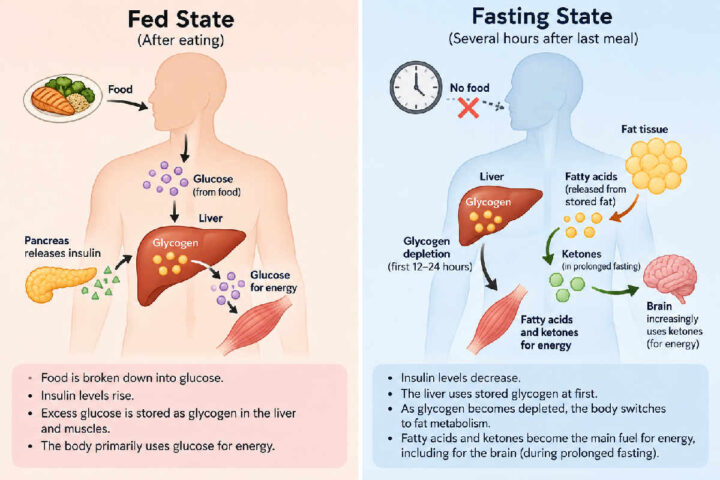
Types of Fasting and How They Affect Energy Usage
There are three representative types of fasting, namely, time-restricted feeding (TRF), intermittent fasting (IF), and fasting-mimicking diet (FMD).3D. Tang, Q. Tang, W. Huang, Y. Zhang, Y. Tian, X. Fu, Fasting: From Physiology to Pathology. Adv. Sci. 2023, 10, 2204487. https://doi.org/10.1002/advs.202204487 Each of these affects how energy is used or generated in its own special way.
1. Time-restricted fasting (TRF)
TRF is a daily fasting pattern in which food intake occurs within a few hours (typically 4 to 12 hours) every day without calorie reduction. In this type of fasting, you get to eat everything you want within a few-hour window in 24 hours, say 8 hours, and then fast for the remaining hours.
This type of fasting takes advantage of the normal circadian rhythm, or the biological clock, especially when the eating hours fall during the day. Energy utilization is higher during the day, while calorie storage is higher at night due to inactivity.
According to research, glucose tolerance is higher during the early hours of the day.4Poggiogalle E, Jamshed H, Peterson CM. Circadian regulation of glucose, lipid, and energy metabolism in humans. Metabolism. 2018 Jul;84:11-27. doi: 10.1016/j.metabol.2017.11.017. Epub 2018 Jan 9. PMID: 29195759; PMCID: PMC5995632. This means the body handles high levels of glucose in the blood better during the day than at night. What this means is that aligning the fasting period of the TRF with nighttime is a natural way of preventing unwanted blood sugar spikes and excessive fat storage at night.
2. Intermittent Fasting (IF)
Intermittent fasting involves alternating periods of eating and extended fasting. There are several types of IF, including the 5:2, the 16/8, the 12-hour, the one meal a day (OMAD), and the alternate-day IF. Read more on the types of intermittent fasting here.
Time-restricted fasting (TRF) may appear similar to some types of intermittent fasting such as the 16:8 and 12-hour types of IF, where fasting is done for 16 hours and 12 hours of the 24 hours in a day, respectively. However, while TRF generally avoids calories during the fasting window, the above types of IF allow a small amount of food (often around 500-600 calories) during the periods of fasting.
Similarly, intermittent fasting affects the body’s energy usage by giving the body enough time to exhaust diet-derived glucose and sufficiently utilize energy stores in the form of fat and glycogen.
3. Fasting-Mimicking Diet (FMD)
FMD refers to a low-calorie plant-based dietary program that aims to provide sufficient micronutrient nourishment, including vitamins and minerals. It is a dietary approach intended to achieve the beneficial effects of fasting without complete food abstinence.
It is typically characterised by limiting caloric intake for five consecutive days in a month over three months. It contains predominantly plant-based foods with low calories, low protein, and relatively high fat. A typical FMD protocol would be ≈1090 calories on the first day (10% protein, 56% fat, and 34% carbohydrate), and subsequently, 725 calories on days 2 to 5 (9% protein, 44% fat, and 47% carbohydrate).5Ibid., Tang et. al., Advanced Science
This type of fasting affects the body’s energy usage by favouring ketogenesis, a beneficial process seen during extended fasting.
Religious Fasting Types
Religious fasting has existed for centuries before the modern scientific classifications of fasting were done. These modes of fasting are largely influenced by the underlying beliefs and cultures.
Fasting across several religions may have inspired the scientific classifications due to some shared similarities.
For example, Muslims abstain from food and drink from dawn to dusk during Ramadan, and eat during the non-fasting hours. Christians have a similar form of intermittent fasting from morning to evening, as well as different forms of restriction during Lent. Some Buddhist fasting practices involve avoiding solid food after midday. Jain traditions include fasting on specific days and certain periods. Yom Kippur in Judaism involves complete fasting from food and water for around 25 hours, while the Daniel Fast in Christianity is a plant-based fasting pattern similar to the fasting-mimicking diet (FMD)
Benefits of Fasting
In addition to being an adjunct to weight control, fasting has immense health benefits. It positively impacts various markers of health, including cardiovascular diseases, cancer, and neurodegenerative diseases, to mention but a few.
Here are some of the benefits of fasting.6Gyimah, L. A. (2024). Fasting physiological effects. In C. M. Drăgoi, I.-B. Dumitrescu, A. Ungurianu, & A. C. Nicolae (Eds.), Insights into the therapeutic applications of fasting. IntechOpen. https://doi.org/10.5772/intechopen.1006645
- It enhances insulin sensitivity: It lowers resting insulin levels, reduces insulin resistance, and lowers the risk of type 2 diabetes.
- Accelerates weight and fat loss, especially when combined with physical exercise: Fasting triggers ketosis through the metabolism of stored fat, preferentially beginning with visceral fat that is not directly affected by physical exercise.
- Boost metabolism: Short-term fasting may rest the digestive system, reduce the dietary supply of glucose, and enhance alternative metabolic reactions in the body.
- Anti-inflammatory effects: Research has shown that fasting reduces inflammatory markers such as C-reactive protein (CRP), tumor necrosis factor-α (TNF-α), and interleukin-6 (IL-6), helping to reduce inflammation associated with chronic conditions such as cardiovascular disease, cancer, and neurodegenerative disorders.
- Enhance cardiovascular health: Studies have shown that 16:8 TRF over 8 weeks and intermittent fasting have a significant effect on improving blood lipid profiles, which are associated with cardiovascular health.
- Enhance autophagy: Autophagy is the cellular process of breaking down damaged organelles and misfolded proteins to reduce oxidative stress and maintain cellular homeostasis.
- Protects against neurodegenerative diseases: Studies have shown that fasting may reduce the accumulation of amyloid-beta proteins, protect against age-related cognitive decline, and reduce neuroinflammation and oxidative stress in the brain.
How to Make the Most of Fasting
Fasting is highly beneficial, but it’s not safe for everyone, particularly during pregnancy or breastfeeding, people with a history of eating disorders, or people with diabetes on medications that have a risk of causing hypoglycemia. To make the most of fasting, you have to understand when you need it and when you don’t.
Fasting is beneficial because it allows the body to make use of stored energy rather than always relying on oral intake every time. But during that time, it might cause you to feel worse, especially at first. You may experience bouts of hunger, tiredness, headaches, irritability, and loss of energy, which is why it may be beneficial to plan well for an upcoming fast.

For example, someone preparing for a religious fasting period may need to plan for the change in eating and sleeping routines. For a Muslim, checking an accurate Ramadan timetable for 2027 may be useful, particularly when work and normal daily activities need to go on.
For weight loss benefits, fasting can safely be combined with physical exercise. To make the most of it without wearing your body down, schedule high-intensity exercise during the eating window, and favor low- and moderate-intensity activities during the fasting period.7Ibid. Zouhal et al., Exercise Training and Fasting: Current Insights.
It is also important to consult a healthcare professional before making drastic changes to your eating patterns.
Common Health Misconceptions About Fasting
Here are common health misconceptions about fasting and their associated facts.
1. The longer you fast, the better
There’s a tendency to make fasting sound like it only counts if the eating window is very short or the fast is difficult. It doesn’t. Short intermittent fasting is equally as effective as longer fasts. Giving the body ample time to fall back on stored energy also comes with associated benefits to health.
2. Your body switches to fat burning at a specific hour
There is no specific hour when fat burning begins. In fact, fat burning coexists with glycogen burning most of the time. This is because your body relies on both carbohydrate and fat sources even at rest.8Spriet LL. New insights into the interaction of carbohydrate and fat metabolism during exercise. Sports Med. 2014 May;44 Suppl 1(Suppl 1):S87-96. doi: 10.1007/s40279-014-0154-1. PMID: 24791920; PMCID: PMC4008806. The relative proportion, however, changes after about 12 to 18 hours when liver glycogen stores have become almost totally depleted.9Patino SC, Orrick JA. Biochemistry – Glycogenolysis. [Updated 2024 Jan 27]. In: StatPearls [Internet]. Treasure Island (FL): StatPearls Publishing; 2024 Jan-. Available from: https://www.ncbi.nlm.nih.gov/books/NBK549820/
3. Fasting automatically makes you lose weight
Fasting doesn’t automatically lead to greater weight loss than reducing calories through a conventional diet. Studies comparing intermittent fasting with continuous calorie restriction diets have found similar weight loss, although some fasting types may have a small advantage in certain circumstances.10Semnani-Azad Z, Khan T A, Chiavaroli L, Chen V, Bhatt H A, Chen A et al. Intermittent fasting strategies and their effects on body weight and other cardiometabolic risk factors: systematic review and network meta-analysis of randomised clinical trials. BMJ 2025; 389:e082007. doi:10.1136/bmj-2024-082007
Fasting and calorie restriction may help you maintain weight by improving your energy balance; that is, not storing more calories than you expend.
4. You can eat whatever you want during your eating window
Food quality still matters. Hydration still matters. Sleep still matters. And getting enough nutrients matters more than hitting an impressive fasting number. Eating too much during your eating window can increase your fat stores, which may require a longer time to burn during fasting.
5. Fasting is safe for everyone
Fasting is not safe for everyone. People with a higher metabolic demand, like pregnant women, lactating mothers, those with a history of eating disorders, or those on medications that predispose to hypoglycemia, require special caution or professional guidance before choosing to fast.
6. Fasting is only about how long you go without food
While the duration of fasting is important, it’s not only about how long you go without food. What you do during your eating window, the quality of your nutrition, and the underlying purpose of your fast matter just as much.
Final words
Whether for religious reasons or otherwise, fasting has been shown to have several health benefits. This is why this topic continues to be an important discussion in health and fitness circles. Fasting helps in weight management and improves some metabolic and cardiovascular health markers.
With respect to metabolism, fasting affects how your body uses energy. Understanding the shift in energy use during fasting, its effects on processes such as autophagy and cellular “housekeeping”, and its relationship with insulin sensitivity can help you better understand some of the potential health benefits of fasting.
But of course, precautions need to be observed, particularly in the presence of underlying medical conditions, a history of eating disorders such as anorexia nervosa, or during pregnancy or lactation. It is important to speak with your doctor if you have any specific concerns before choosing to fast.
References
| ↑1 | Zouhal H, Saeidi A, Salhi A, Li H, Essop MF, Laher I, Rhibi F, Amani-Shalamzari S, Ben Abderrahman A. Exercise Training and Fasting: Current Insights. Open Access J Sports Med. 2020 Jan 21;11:1-28. doi: 10.2147/OAJSM.S224919. PMID: 32021500; PMCID: PMC6983467. |
|---|---|
| ↑2 | University of Rochester Medical Center. (n.d.). Two-hour postprandial glucose. Health Encyclopedia. |
| ↑3 | D. Tang, Q. Tang, W. Huang, Y. Zhang, Y. Tian, X. Fu, Fasting: From Physiology to Pathology. Adv. Sci. 2023, 10, 2204487. https://doi.org/10.1002/advs.202204487 |
| ↑4 | Poggiogalle E, Jamshed H, Peterson CM. Circadian regulation of glucose, lipid, and energy metabolism in humans. Metabolism. 2018 Jul;84:11-27. doi: 10.1016/j.metabol.2017.11.017. Epub 2018 Jan 9. PMID: 29195759; PMCID: PMC5995632. |
| ↑5 | Ibid., Tang et. al., Advanced Science |
| ↑6 | Gyimah, L. A. (2024). Fasting physiological effects. In C. M. Drăgoi, I.-B. Dumitrescu, A. Ungurianu, & A. C. Nicolae (Eds.), Insights into the therapeutic applications of fasting. IntechOpen. https://doi.org/10.5772/intechopen.1006645 |
| ↑7 | Ibid. Zouhal et al., Exercise Training and Fasting: Current Insights. |
| ↑8 | Spriet LL. New insights into the interaction of carbohydrate and fat metabolism during exercise. Sports Med. 2014 May;44 Suppl 1(Suppl 1):S87-96. doi: 10.1007/s40279-014-0154-1. PMID: 24791920; PMCID: PMC4008806. |
| ↑9 | Patino SC, Orrick JA. Biochemistry – Glycogenolysis. [Updated 2024 Jan 27]. In: StatPearls [Internet]. Treasure Island (FL): StatPearls Publishing; 2024 Jan-. Available from: https://www.ncbi.nlm.nih.gov/books/NBK549820/ |
| ↑10 | Semnani-Azad Z, Khan T A, Chiavaroli L, Chen V, Bhatt H A, Chen A et al. Intermittent fasting strategies and their effects on body weight and other cardiometabolic risk factors: systematic review and network meta-analysis of randomised clinical trials. BMJ 2025; 389:e082007. doi:10.1136/bmj-2024-082007 |














You Might Also Like