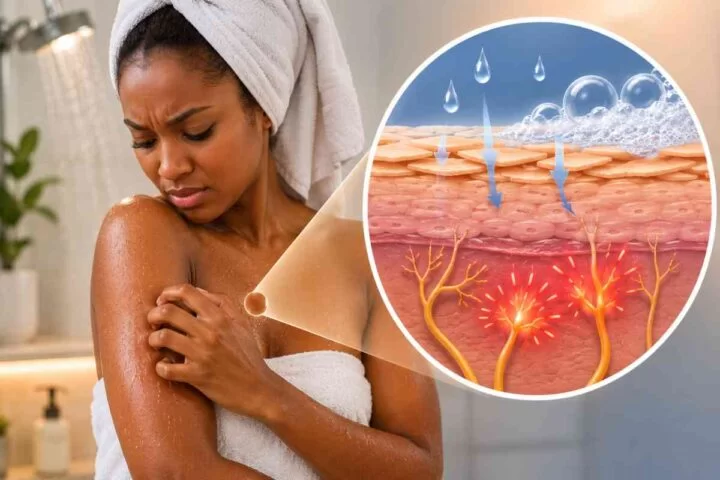
Have you ever finished taking a bath and noticed an intense itching sensation all over your body? You’re not alone. Many people experience this frustrating problem even when there is no visible rash or irritation on the skin.
The itching is often described as tiny prickling-like sensations that move from one area of the body to another. They are usually felt on the arms, trunk, and back, almost immediately after bathing, as water dries from the skin.
For some people, simply becoming aware of the itching or the sight of dirty, brownish colors can make it feel worse, while lightly rubbing or touching the skin provides temporary relief. This experience usually lasts only for a few minutes, but it may become so frequent that some people dread taking a bath or avoid bathing altogether.
I’ve experienced this symptom myself, which led me to explore the medical literature and research several solutions to this issue. While little is discussed about this condition, it has several recognized medical causes. The commonest being a mild form of what is called Aquagenic Pruritus.
In this article, we’ll explore why your skin itches after bathing, what may be triggering it in your case, and practical ways to prevent it after every bath.
How Common is Itching After Bathing?
Itching after a bath is quite common and has been described as post-bath itching or aquagenic pruritus in several medical research publications.
A 2009 study in Edo State, Nigeria, showed that 23.8% of respondents experienced post-bath itching or aquagenic pruritus, with a majority being males (62.5%) compared to females (37.5%). This study also highlighted that the average duration of this itching is about 5.5 minutes after bathing.1Salami, T. A., Samuel, S. O., Eze, K. C., Irekpita, E., Oziegbe, E., & Momoh, M. O. (2009). Prevalence and characteristics of aquagenic pruritus in a young African population. BMC dermatology, 9, 4. https://doi.org/10.1186/1471-5945-9-4
Another study among residents of Ekpoma, Edo State, Nigeria, reported a prevalence as high as 60%, stating that post-bath itching is commonest after bathing with rain water (23%), followed by cold water (19%), and then by well water (17%). This study also showed that warm water baths reduced itching after bathing in people who frequently experience it.2H.O. Otamere, U. Akpamu, D.E. Odiase, & E.N.S. Osarenotor. (2022). Post-bath itching in Ekpoma and environs: A disturbing prevalence rate. African Journal of Biomedical Research, 25(3), 347–351. https://doi.org/10.4314/ajbr.v25i3.10
Other reported studies showed occurrence rates of 21% in Lagos State, Nigeria3Salami, T. A., Samuel, S. O., Eze, K. C., Irekpita, E., Oziegbe, E., & Momoh, M. O. (2009). Prevalence and characteristics of aquagenic pruritus in a young African population. Ibid., 21/8% in Lome, Togo4Teclessou, J. N., Kombate, K., Akakpo, A. S., Mouhari-Toure, A., Zoua, J., Kassang, P., Saka, B., & Pitche, P. (2020). Prevalence and Clinical Characteristics of Aquagenic Pruritus among Medical and Pharmacy Students in Lomé (Togo). Dermatology research and practice, 2020, 8420123. https://doi.org/10.1155/2020/8420123, and 4.5% in Negev, Israel.5Potasman, I., Heinrich, I., & Bassan, H. M. (1990). Aquagenic pruritus: prevalence and clinical characteristics. Israel journal of medical sciences, 26(9), 499–503.. These variations emphasize that itching after bathing may be found across several populations globally, but how commonly it occurs may be influenced by population-specific characteristics, including climate, bathing habits, and water sources.
Why Does Your Skin Itch After Bathing
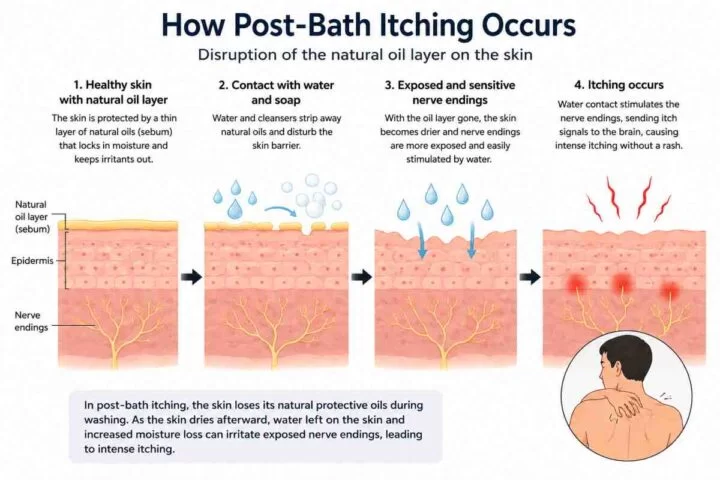
While there are several causes of skin itching after taking a bath, the commonest cause is mild skin hypersensitivity due to a disruption in the skin’s natural oil barrier by soaps, surfactants, and water chemicals. This makes the nerve endings easily irritated in people with dry skin, causing itching a few seconds after bathing.
Causes of Skin Itching After Bathing
The possible causes of post-bath skin itching can be grouped into three broad categories:
- Soap- or irritant-related irritation
- Aquagenic pruritus
- Underlying skin or medication conditions
In this section, we will explore these causes of post-bath itching and what’s the most likely cause in your own case.
1. Soap Irritation
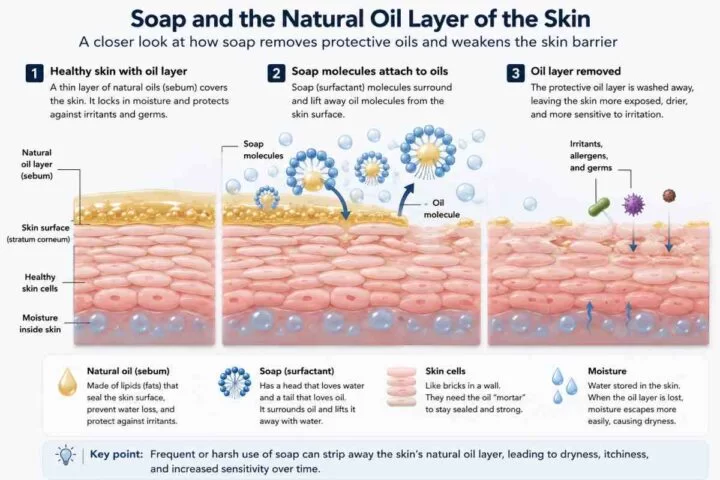
Soap irritation is the commonest and most likely cause of skin itching after bathing without visible skin rashes or lesions, and it is more common in people with naturally dry skin. Dry skin produces a lower amount of protective lipids like ceramides, cholesterol, free fatty acids, and sebum, making it more likely to lose the oil layer during bathing.
Soaps contain surfactants that can wash away the oil layer on the skin’s surface, exposing the sensitive layer beneath. This explains why you might experience itchy skin after bathing.
Alkaline Soaps
Some soaps are more likely to cause post-bath itching than others due to their chemical formulations. These include soaps that are alkaline in their chemical composition. Some moisturizing soap bars (known as synthetic detergents) are formulated closer to the skin’s natural pH, making them less irritating to the skin’s oily layer.
Traditional soaps are mainly alkaline and contain ingredients such as Sodium Palmate, Sodium Palm Kernelate, Sodium Tallowate, Sodium Cocoate, and Sodium Olivate. On the other hand, synthetic detergents (syndet soaps) have a more acidic pH closer to the skin’s pH, and contain ingredients such as Sodium Cocoyl Isethionate, Sodium Lauroyl Sarcosinate, etc.
Due to how soaps interact with the skin’s oil layer, they can predispose people with dry and sensitive skin to skin itching after bathing.
Hard Water and Water Chemicals
Hard water contains high amounts of dissolved minerals, particularly calcium and magnesium. These minerals can react with soap to form residues that are difficult to rinse away with water. These residues may further disrupt the skin barrier, increase dryness, and make the skin more susceptible to irritation and itching after bathing.
In some communities, people add disinfectants and antiseptics to their bath water in the hope of preventing skin infections and relieving itching after bathing. While these may help reduce germs when used appropriately, they can cause skin irritation and itching when used excessively.
Water Temperature
The temperature of the bath water can also affect skin sensitivity in susceptible individuals. Cold water increases skin sensitivity, while very hot water may more rapidly remove the protective lipid barrier. These can predispose to skin itching after bathing.
In contrast, warm water provides better relief from skin irritation after a bath. It has a soothing effect on the skin, does not easily wash off the protective lipid layer, and can better dissolve minerals and soap residues to prevent dryness and irritation.
2. Aquagenic pruritus
Aquagenic pruritus is a specific clinical syndrome characterized by itching, prickling, burning, or other skin discomfort, whether mild or severe, that occurs after contact with water and is accompanied by no visible skin lesions. These symptoms are provoked by any temperature, pH, or water salinity.
Unlike soap-related irritation, aquagenic pruritus is triggered by contact with water itself, even when no soap or cleanser is used. Proposed mechanisms for this phenomenon include mast-cell activation, histamine release, abnormal activation of itch-sensitive nerve fibers, and increased cutaneous fibrinolytic activity. However, the exact cause remains unknown.6Sekar, C. S., Srinivas, C. R., & Jacob, S. (2011). Aquagenic pruritus: beneath water “lies”. Indian journal of dermatology, 56(4), 446–447. https://doi.org/10.4103/0019-5154.84734
3. Medical conditions
Post-bath itching can also occur from skin infections and some systemic medical conditions. Examples of such skin infections include atopic dermatitis, contact dermatitis, and psoriasis. However, most skin infections cause visible skin changes such as redness, bumps, blisters, crusting, or pus-filled lesions.
Aquagenic pruritus, which is the clinical diagnosis of post-water itching, may less frequently be associated with systemic conditions like myelodysplastic syndrome, polycythaemia rubra vera, lymphoblastic leukaemia, T-cell non-Hodgkin’s lymphoma, metastatic squamous cell carcinoma, hepatitis C infection, juvenile xanthogranuloma, and acute leucocytoclastic vasculitis. Other than juvenile xanthogranuloma and acute leukocytoclastic vasculitis, which cause visible skin lesions, the others present as rashless skin itching.
Of the systemic medical causes of skin itching listed above, polycythemia vera deserves special attention because it is the only one where contact with water triggers an intense burning or stinging sensation, regardless of temperature.7Lelonek, E., Matusiak, Ł., Wróbel, T., & Szepietowski, J. C. (2018). Aquagenic pruritus in polycythemia vera: Clinical characteristics. Acta Dermato-Venereologica, 98(5), 496–500. https://doi.org/10.2340/00015555-2906 For the rest, skin itching already exists, but becomes more noticeable after bathing.
Other causes of skin itching after bathing include idiopathic hypereosinophilic syndrome, drugs such as bupropion and chloroquine.
How To Stop or Prevent the Itching After Bathing
Stopping skin itching after bathing is about preventing the disruption of the protective lipid layer on the skin. That layer has to remain intact, especially in those with dry, sensitive skin.
Some of the documented home-based interventions for post-bath itching from the research studies in this post include the following:
- Taking shorter baths
- Using milder scrubs
- Bathing with warm water
- Moisturizing within minutes of bathing
- Adding baking soda or vinegar to soften bath water, and
- Taking antihistamine medications before and after bathing
However, little was said about the efficacy of the above methods in preventing post-bath itching. I have also personally tried most of the above methods, if not all, and I can verify that they don’t really help prevent or stop the experience as such.
When approaching the treatment or prevention of skin itching after bathing, it is only logical to first consider soap irritation as the cause of your post-bath itching before secondary causes like medical conditions and skin infections. This is even more appropriate, especially when there are no visible rashes on the skin during itching.
Modifying soaps, bath frequency, and water hardness may help, but here is what actually works… Lather soap before scrubbing your skin.
1. Lather soap properly before scrubbing
In my own experience with skin itching after bathing, I tried most of the methods discussed above until recently, when I noticed that thoroughly lathering bar soap before applying it to the skin, or using a mild liquid wash, prevented skin itching after bathing.
Before scrubbing your skin, work your soap into a rich lather before applying it to your skin.
- Apply some soap to your sponge.
- Then vigorously scrub the sponge in your palm until the soap lathers completely. It should appear whiter than usual.
- Then, scrub your body gently.
- Repeat the process if you have to reapply more soap to your sponge.
This prevents direct contact of the undissolved soap with your skin, and it’s especially important when using an alkaline soap.
Applying soap directly to your skin can wash away the protective lipid layer, especially in people who naturally produce less of these substances.
After discovering this solution myself, I recommended it to a patient with similar symptoms. After trying it, she later reported that her itching also resolved with this simple intervention. And while these testimonies are not enough evidence that this method works for everyone, they answer the once-unanswered question of why most people experience skin itching after bathing, without any visible rash.
2. Keep your skin moisturized
Moisturizing your skin helps to protect the protective lipid layer on the skin, preventing skin dryness and irritation. Avoid creams that contain proven harsh chemicals or bleaching agents. These can break the skin’s natural protection and predispose it to skin itching after bathing.
3. Bath with warm water
Warm water can provide soothing to the skin and prevent skin itching in people who experience post-bath itching. This is because it reduces the sensitivity of the nerve endings responsible for causing itching on the skin. However, this method does not offer a permanent solution to the issue of post-bath itching in the absence of visible rashes.
Warm water also helps to dissolve water chemicals that may irritate the skin after bathing.
4. Baking soda or vinegar to soften bath water
Baking soda or vinegar can be used to soften bath water. Thus, if water chemicals like calcium and magnesium residues are the primary cause of your post-bath itching, this can be a viable solution.
Other ways to soften bath water include installing a house water-softening system.
5. Take short baths
Taking longer baths will not help prevent skin itching; it may worsen it. This is because skin itching after bathing is often related to a disruption of the protective skin layer, and not necessarily due to dirt on the skin. Too much scrubbing and longer baths may therefore worsen itching rather than prevent it.
6. Use a milder soap
Most traditional soaps are alkaline in nature, which makes them harsher on the skin, especially for those who have naturally dry skin. If your soap contains any of these ingredients, it is likely an alkaline soap. On the other hand, syndet soaps (containing synthetic detergents) have a more acidic pH closer to the skin’s pH and are milder on it.
When to See a Doctor
If all the home remedies above do not work, your skin itching may be due to an underlying medical condition that requires seeing a doctor. Here are some situations when you’d need to see a doctor for itching skin after bathing.
- Lasts longer than 30-60 minutes
- Visible rashes on the skin
- Itching persists after trying all the home remedies possible
- Presence of associated symptoms like fever, night sweats, etc.
- Worsening itching that causes significant daily discomfort
- Itching interferes with your sleep
- Itching occurs without any known external triggers, like bathing.
Quick Relief for Skin Itching After Bathing
Because most post-bath itching without a rash often subsides spontaneously within 5-10 minutes, a quick relief is often not what most people want. But if your skin itching persists longer than 10 minutes every time, here are some quick relief methods you can try.
- Dampen your skin with a mild moisturizer, preferably a fragrance-free moisturizer
- Apply a cool (not cold) compress on the itchy areas
- Gently rub your hand over itchy areas. Avoid scratching
- Stay in a cool place until the itching subsides
- Wear loose, breathable clothing to protect your skin directly from the wind and prevent mild irritation.
Frequently Asked Questions
Is itching after bathing normal?
Although many people experience itching after bathing, it is not considered a normal response after bathing. Healthy skin should not itch after contact with water. Thus, having itching skin after bathing can mean that something abnormal is happening.
Fortunately, most cases of post-bath itching are mild and can be improved by changing bathing habits. Use gentler cleansers, moisturize regularly, and lather soap properly before washing your body.
Can soap cause itching after bathing?
Yes. Soap can cause itching after bathing in people with dry or sensitive skin. Traditional alkaline soaps (the ones we commonly use) contain harsh surfactants that can remove some of the skin's protective lipids. This increases skin dryness, making the skin more susceptible to irritation and itching after bathing.
Why doesn't liquid soap make me itch?
Many liquid body washes are formulated with milder cleansing agents and a pH closer to the skin's natural acidity. They may also contain moisturizing ingredients that help protect the skin barrier. In addition, unlike bar soaps, liquid soaps easily form lather on the skin when mixed with water, avoiding direct irritation to the skin barrier.
Can hard water cause post-bath itching?
Hard water contains high concentrations of calcium and magnesium, which can make it more difficult to rinse soap residues away completely. In people with dry or sensitive skin, this can contribute to skin irritation and post-bath itching, but it is rarely the only cause of post-bath itching.
Why is the itching worse with cold water?
Though the exact reason is not fully understood, cold water may stimulate temperature-sensitive nerve fibres more readily. This makes post-bath itching worse with cold water than with warm water. In contrast, hot water can worsen skin dryness and itching by removing more of the skin's protective oils, making lukewarm water the most preferred choice.
What is the difference between post-bath itching and aquagenic pruritus?
Post-bath itching is a symptom that can arise from different causes, including soap irritation, dry skin, eczema, hard water, and aquagenic pruritus. Aquagenic pruritus is a specific medical condition where contact with water triggers intense itching, irrespective of the temperature or chemical constituents of the water. It is often diagnosed after other possible causes of water-related itching have been excluded.
How long should itching after bathing last?
Most cases of post-bath itching should resolve on their own within 5 to 10 minutes. If it lasts longer or becomes severe, seek medical advice immediately, as that could be a sign of a serious underlying condition that demands medical attention.
How can I stop itching immediately after bathing?
While there is no specific way to stop skin itching immediately after it begins, you can get faster relief by applying a fragrance-free moisturizer while the skin is still slightly damp. Use a cool compress, wear loose clothing, and stay in a cool environment until the itching settles.
When should I see a doctor?
See a doctor if your itching lasts longer than expected, becomes severe, or does not respond to effective home remedies. If accompanied by a rash, blisters, redness, or swelling, it could be a sign of an underlying health problem. Also seek medical attention if itching is associated with symptoms such as unexplained weight loss, persistent fever, night sweats, or yellowness of the skin or eyes.
Final words
Skin itching after taking a bath can be a very frustrating experience for some people, but most cases of post-bath itching are mild. With the right tips, you can permanently put an end to skin itching after taking a bath.
However, if the most effective home remedies fail to resolve your post-bath itching, it will be necessary to seek medical attention immediately. This post shared some of the most effective home tips to relieve and prevent this experience after bathing.
I have tried them myself, and I am pretty sure you will find this information helpful. Drop a comment, bookmark this page, and share with those who might also need this information.
References
| ↑1 | Salami, T. A., Samuel, S. O., Eze, K. C., Irekpita, E., Oziegbe, E., & Momoh, M. O. (2009). Prevalence and characteristics of aquagenic pruritus in a young African population. BMC dermatology, 9, 4. https://doi.org/10.1186/1471-5945-9-4 |
|---|---|
| ↑2 | H.O. Otamere, U. Akpamu, D.E. Odiase, & E.N.S. Osarenotor. (2022). Post-bath itching in Ekpoma and environs: A disturbing prevalence rate. African Journal of Biomedical Research, 25(3), 347–351. https://doi.org/10.4314/ajbr.v25i3.10 |
| ↑3 | Salami, T. A., Samuel, S. O., Eze, K. C., Irekpita, E., Oziegbe, E., & Momoh, M. O. (2009). Prevalence and characteristics of aquagenic pruritus in a young African population. Ibid. |
| ↑4 | Teclessou, J. N., Kombate, K., Akakpo, A. S., Mouhari-Toure, A., Zoua, J., Kassang, P., Saka, B., & Pitche, P. (2020). Prevalence and Clinical Characteristics of Aquagenic Pruritus among Medical and Pharmacy Students in Lomé (Togo). Dermatology research and practice, 2020, 8420123. https://doi.org/10.1155/2020/8420123 |
| ↑5 | Potasman, I., Heinrich, I., & Bassan, H. M. (1990). Aquagenic pruritus: prevalence and clinical characteristics. Israel journal of medical sciences, 26(9), 499–503. |
| ↑6 | Sekar, C. S., Srinivas, C. R., & Jacob, S. (2011). Aquagenic pruritus: beneath water “lies”. Indian journal of dermatology, 56(4), 446–447. https://doi.org/10.4103/0019-5154.84734 |
| ↑7 | Lelonek, E., Matusiak, Ł., Wróbel, T., & Szepietowski, J. C. (2018). Aquagenic pruritus in polycythemia vera: Clinical characteristics. Acta Dermato-Venereologica, 98(5), 496–500. https://doi.org/10.2340/00015555-2906 |













You Might Also Like