From a clinical perspective, breast sagging is not a common presenting complaint. However, it remains a common concern that comes up in everyday conversation. Yet, there are inaccurate assumptions about what causes it and how to manage it.
Saggy breasts, known medically as breast ptosis, occur when the breasts gradually lose their firmness and shape, resulting in a drooping of the breast tissue. This occurs due to a loss of elasticity in the skin and the Cooper’s ligaments, which help support the breast tissue.
Breast sagging is a natural process that affects most women at some point in their lives. Though its development is affected by normal aging, the influence of gravity, hormonal changes, and body weight fluctuations, several misconceptions still surround why it happens and what can be done about it.
In this post, we will take a closer look at the specific causes of saggy breasts, clear up the common misconceptions about the process, and discuss realistic ways to manage the condition.
What Causes Saggy Breasts?
Saggy breasts occur as part of the natural aging process, but the underlying cause is largely due to the irreversible stretching of Cooper’s ligaments. The Cooper’s ligaments (also known as suspensory ligaments) are fibrous bands that help to connect the skin over the breast to the underlying chest wall (muscle layer). Within the space is the breast tissue, composed mainly of fat and glandular tissue.
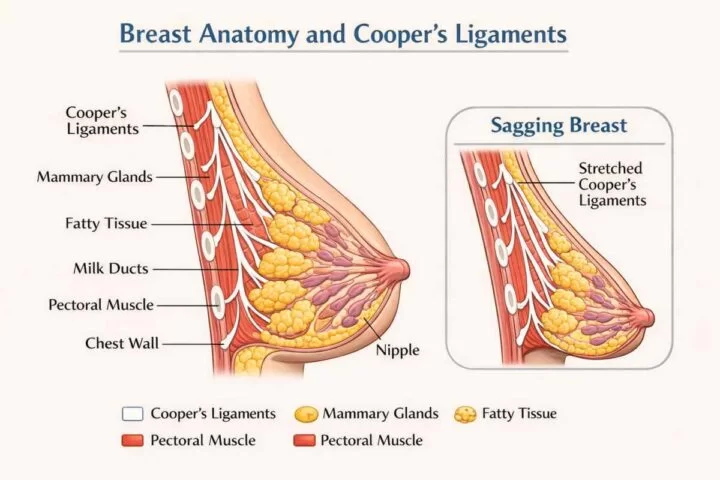
When the Cooper’s ligaments (also known as suspensory ligaments) are firm and intact, they help support the shape and position of the breast. However, as they become stretched and lax over time, they allow the breast tissue to gradually droop, as illustrated in the image above.
As you will see in this section, mechanical factors, age-related changes, and lifestyle habits are important factors that lead to breast sagging, particularly in women.
1. Aging
Aging is one of the most important causes of breast sagging. This is because it is associated with a loss of skin elasticity due to a reduction in the production of collagen and elastin in the skin and connective tissues of the breast.
Collagen and elastin production decline with age, while their breakdown increases. This results in the stretching and laxness of the Cooper’s ligament and overlying breast skin, leading to saggy breasts.1Hussein, R. S., Bin Dayel, S., Abahussein, O., & El-Sherbiny, A. A. (2025). Influences on Skin and Intrinsic Aging: Biological, Environmental, and Therapeutic Insights. Journal of Cosmetic Dermatology, 24(2), e16688. https://doi.org/10.1111/jocd.16688
2. Genetics
Genetics influences breast sagging because it can determine the size of a woman’s breasts, as well as the ratio of glandular tissue to fat in the breasts. Women with higher breast fat distribution tend to have larger breasts and, thus, experience more sagging over time.
Genetics can also affect the amount, quality, and rate of production of elastin and collagen in the body. People who have less of these proteins are prone to having less elastic/firm skin and Cooper’s ligaments, which can contribute to sagging breasts at an earlier age.2Romero-Ortuno, R., Kenny, R. A., & McManus, R. (2020). Collagens and elastin genetic variations and their potential role in aging-related diseases and longevity in humans. Experimental gerontology, 129, 110781. https://doi.org/10.1016/j.exger.2019.110781
In addition, congenital connective tissue diseases like Ehlers-Danlos syndrome can affect the quality of collagen and elastin, making the breasts more prone to sagging.
3. The effects of gravity
Gravity causes an irreversible stretching of Cooper’s ligaments and weakness of the overlying skin, which results in saggy breasts over time. This is because the breasts naturally project outwards from the chest wall, making them prone to the downward effect of gravity. This effect tends to be more pronounced in women with larger breasts due to the increased overall weight of the breasts.
It is important to note, however, that bras have not been shown to stop the natural effects of gravity and aging on breast tissue. Thus, while they can provide comfort and reduce strain due to physical activity, there is no strong evidence that their regular use prevents breast sagging.
4. Pregnancy changes in the breast
Pregnancy and breastfeeding are also important causes of saggy breasts in women. Hormonal changes during pregnancy result in an increase in the size of the breast tissues, which can lead to excessive stretching of the skin and Cooper’s ligaments. An increase in breast size also increases the effect of gravity on the breast tissue.
During lactation, breastmilk fills the engorged breast glands, giving the breasts a smooth, firm outline. But at the end of lactation, the glands shrink, leaving the breast tissues and skin unsupported by the lax ligaments, further worsening breast sagging.
5. Frequent weight fluctuations
Weight fluctuations can cause saggy breasts in the same mechanism as pregnancy. During weight gain, there is an increase in the size and mass of fat cells in the breast tissue. This causes a proportionate stretching of the breast ligaments, which can eventually lead to breast ptosis.
On the other hand, weight loss results in a reduction in fatty tissues of the breast. And as this occurs, breast ligaments, which have been overstretched after the weight gain, become too lax to support the shrunken breast tissue after the weight loss. The degree of sagging after weight loss can vary depending on age, skin elasticity, how rapidly the weight change occurred, and the amount of weight lost.
6. Lifestyle factors
Lifestyle factors such as smoking, poor nutrition, and inadequate breast support during high-impact activity can contribute to saggy breasts in women.
According to research, tobacco smoking and its by-products promote the production of metalloproteinases (MMPs), which break down collagen and elastin in the skin and connective tissue. This can impair the skin’s ability to repair itself, cause lax breast ligaments, and promote saggy breasts.3Lahmann, C., Bergemann, J., Harrison, G., & Young, A. R. (2001). Matrix metalloproteinase-1 and skin ageing in smokers. Lancet (London, England), 357(9260), 935–936. https://doi.org/10.1016/S0140-6736(00)04220-3
Smoking also causes constriction of blood vessels near the skin, leading to poor blood supply, skin atrophy, and shrinking of the breast tissue. This also reduces the skin’s elasticity, causing breast ptosis.4Farage, M. A., Miller, K. W., Elsner, P., & Maibach, H. I. (2008). Intrinsic and extrinsic factors in skin ageing: A review. International Journal of Cosmetic Science, 30(2), 87-95. https://doi.org/10.1111/j.1468-2494.2007.00415.x
Poor nutrition causes significant weight loss, which can cause saggy breasts, while lack of supportive bras may contribute to increased strain on the breast tissues during high-impact activities.
Another important lifestyle factor that can cause breast ptosis is exposure to sunlight. UV light from skin tanning can break down collagen and elastin in breast tissue.
7. Menopause
At menopause, estrogen production declines significantly, and this affects several aspects of a woman’s appearance, including the breasts. Estrogen enhances connective tissue elasticity and fat deposition, and menopausal levels are insufficient to maintain these effects.
This results in reduced breast fat, reduced breast connective tissue elasticity, and reduced elasticity of the skin over the breasts, making breast sagging more prominent. This explains why saggy breasts are a common finding in post-menopausal women.
Common Misconceptions Around Sagging Breasts
Several misconceptions still surround saggy breasts due to poor knowledge of their causes and how to manage them. Here are some common misconceptions of breast ptosis debunked.
1. Only large breasts sag
Both large and small breasts sag because sagging occurs due to the ratio of glandular tissue to fat tissue, not necessarily because of the breast size itself. A higher fat-to-glandular tissue ratio increases the likelihood of sagging, and vice versa. Other factors like weight fluctuations, smoking, and unprotected sunlight exposure can also contribute to breast ptosis, regardless of size.
2. Breastfeeding can directly cause breast sagging
Research has shown that breastfeeding does not cause breast drooping, but this myth can make some women hesitate or avoid breastfeeding their babies. Breastfeeding babies only have to nurse on the milk from the glands without causing any effect on the skin or Cooper’s ligaments. Breast sagging after weaning is more likely due to the effect of pregnancy on the breasts than from breastfeeding.
3. Breast sagging in a young girl is due to regular sex or intimate contact
This is another popular misconception that breast ptosis in a young woman means they have been too sexually active. However, there is no medical evidence that regular sex, intimate touching, or breast cuddling can lead to sagging. Temporary physical contact does not weaken the skin or supporting ligaments of the breast, as this is due mainly to the prolonged effects of gravity, aging, and breast changes, among others.
4. Certain creams and pills can prevent or treat sagging
Beware of creams and pills that promise to prevent or treat saggy breasts. Sagging results from weakened skin and breast ligaments, and this effect cannot be reversed or prevented by creams or pills.
While hormonal (estrogen) replacement can influence breast size through stimulating glandular growth, fat deposition, and increased connective tissue elasticity, there is no safe, widely accepted pharmacological solution for breast enlargement in women.5Haider, R., Ahmed, Z., & Das, G. K. (2025). Pharmacological and hormonal approaches to breast enlargement: A clinical and scientific review. Journal of Endocrinology and Disorders, 9(3). https://doi.org/10.31579/2640-1045/22
5. Exercise causes breast drooping
Research shows that exercise does not significantly weaken the breast ligaments, but high-impact exercises like running may put some strain on the skin of the breast. However, this is not enough to cause breast sagging, particularly because most women wear supportive bras during such high-impact exercises.
On the other hand, exercise also does not reverse sagging but may help strengthen the muscle beneath the breast tissue, which can improve the appearance of the chest.
Can Saggy Breasts be Prevented or Managed?
Breast ptosis is a natural process that cannot be completely prevented. The structure of the breast and the effect of gravity make breast sagging almost inevitable, and this is further influenced by pregnancy, hormonal changes, weight fluctuations, and lifestyle habits.
However, certain measures can help slow its progression or improve the overall breast appearance.
Preventive Measures for Drooping Breasts
These involve focusing on long-term habits that reduce strain on the breast tissues. Normal aging, pregnancy, and childbearing can accelerate the process. Thus, the aim is not to completely stop or prevent breast sagging but to slow its progression.
Here are some helpful measures:
- Maintain a stable weight: Repeated stretching and shrinking of the skin can accelerate the weakening of the breast supporting ligaments over time. An increase in breast tissue fat increases the impact of gravity on the suspensory ligament, and when the weight has been shed, the loose skin becomes unsupported by the lax ligaments.
- Wear supportive bras in high-impact activities: High-impact activities are those that cause significant bouncing and vertical motion of the breast, causing strain on the breast tissues and accelerating sagging. These include running, jogging, jumping rope, and court sports, etc. Supportive bras will help cushion the effect on the breast and reduce sagging.
- Avoid smoking: Smoking has been shown to produce substances that accelerate the breakdown of collagen and elastin to cause breast sagging or make it appear earlier.
- Avoid too much sun exposure: Ultraviolet light from the sun can break down collagen and elastin in the skin. Too much sun exposure or sun tanning over the breast can accelerate breast drooping in women.
- Adequate nutrition: Good nutrition rich in essential nutrients like proteins, vitamins, and minerals is beneficial to the body. It supports skin health and helps maintain the integrity of connective tissue structures.
Management Options for Saggy Breasts
The management of saggy breasts can be categorized into non-medical/non-surgical and surgical options.
A. Non-surgical options include:
- Chest (pectoral muscles) exercises: These improve appearance by strengthening the underlying pectoral muscles, but not necessarily strengthen the Cooper’s ligaments or the overlying skin.
- Posture: Maintaining an upright posture can help lift the chest, align the spine, and reduce the effects of gravity on the breast tissue.
- Proper bra fitting: A properly fitted bra can improve the appearance of the breasts and also reduce strain during high-impact activities.
- Skin care and nutrition: Good hydration and a balanced diet can keep the skin supple and healthy. Skin care creams and topical products do not significantly affect breast lifting, but they may help maintain overall skin quality.
B. Medical/Surgical Options
- Breast lift (mastopexy): Mastopexy or breast lift is a surgical procedure done to raise, tighten, and reshape sagging breasts. It primarily involves repositioning the nipple-areola complex (NAC) to a higher position, thus correcting a sagging breast.6Toomey AE, Cape JD. Mastopexy (Breast Lift) [Updated 2024 Dec 11]. In: StatPearls [Internet]. Treasure Island (FL): StatPearls Publishing; 2026 Jan-. Available from: https://www.ncbi.nlm.nih.gov/books/NBK610682/
- Breast augmentation: Augmentation, sometimes performed together with mastopexy, is a procedure used to increase breast volume in cases where there was excess volume loss. Significant weight loss following an initial weight gain can often leave the breasts looking flabby and worsen the sagginess. Augmentation helps to restore the bulk of the breast and reduce saggy breasts.7Ibid. Toomey AE, Cape JD. Mastopexy (Breast Lift)
Breast sagging is part of the natural aging process
It is mainly caused by structural and biological changes in the breast tissue
Myths like sex, exercise, and causing sagging are not true
Management focuses on slowing progression, rather than preventing it completely
Conclusion
Breast sagging is a natural and often unavoidable process, often influenced by aging, genetics, and lifestyle. Understanding its causes can help address the misconceptions surrounding it and make informed decisions about your body.
With appropriate lifestyle measures and medical options where necessary, women can make better decisions towards addressing breast sagging.
If you have concerns regarding the appearance or changes in your breasts, speak with a qualified healthcare professional for personalized advice. Also, explore more of our health articles for practical insights for your overall well-being.
References
| ↑1 | Hussein, R. S., Bin Dayel, S., Abahussein, O., & El-Sherbiny, A. A. (2025). Influences on Skin and Intrinsic Aging: Biological, Environmental, and Therapeutic Insights. Journal of Cosmetic Dermatology, 24(2), e16688. https://doi.org/10.1111/jocd.16688 |
|---|---|
| ↑2 | Romero-Ortuno, R., Kenny, R. A., & McManus, R. (2020). Collagens and elastin genetic variations and their potential role in aging-related diseases and longevity in humans. Experimental gerontology, 129, 110781. https://doi.org/10.1016/j.exger.2019.110781 |
| ↑3 | Lahmann, C., Bergemann, J., Harrison, G., & Young, A. R. (2001). Matrix metalloproteinase-1 and skin ageing in smokers. Lancet (London, England), 357(9260), 935–936. https://doi.org/10.1016/S0140-6736(00)04220-3 |
| ↑4 | Farage, M. A., Miller, K. W., Elsner, P., & Maibach, H. I. (2008). Intrinsic and extrinsic factors in skin ageing: A review. International Journal of Cosmetic Science, 30(2), 87-95. https://doi.org/10.1111/j.1468-2494.2007.00415.x |
| ↑5 | Haider, R., Ahmed, Z., & Das, G. K. (2025). Pharmacological and hormonal approaches to breast enlargement: A clinical and scientific review. Journal of Endocrinology and Disorders, 9(3). https://doi.org/10.31579/2640-1045/22 |
| ↑6 | Toomey AE, Cape JD. Mastopexy (Breast Lift) [Updated 2024 Dec 11]. In: StatPearls [Internet]. Treasure Island (FL): StatPearls Publishing; 2026 Jan-. Available from: https://www.ncbi.nlm.nih.gov/books/NBK610682/ |
| ↑7 | Ibid. Toomey AE, Cape JD. Mastopexy (Breast Lift) |












You Might Also Like