
The four temperament types are Sanguine, Choleric, Melancholic, and Phlegmatic. This is a classification system from ancient Greek medicine that is still used today to understand human personality and behavior. It derives from four bodily humors: blood, phlegm, yellow bile, and black bile.
In this guide, you will see how these temperament types were derived, their traits, strengths, weaknesses, and how each of them connects to modern personality frameworks like Myers-Briggs and the Big Five.
Not sure which temperament describes you? Take the free four temperament test to discover your primary and secondary temperaments.
What are the Four Temperament Types?
The four temperament types are based on the four temperament theory originated by Hippocrates, the father of modern medicine, who described how the body’s predominant fluid/humor can influence human behavior. These include Sanguine (from blood), Choleric (yellow bile), Phlegmatic (phlegm), and Melancholic (black bile).
According to Hippocrates, excess blood (sanguine) made people more lively, warm, and energetic; excess phlegm (phlegmatic) made people more sluggish and calm; excess yellow bile (choleric) made people more excitable and aggressive; while excess black bile (melancholic) made people more despondent and depressed.
- The sanguine => The buoyant type.
- The phlegmatic => The sluggish type.
- The choleric => The quick-tempered type.
- The melancholic => The dejected type.
This psychological system was proposed as a measure of medical imbalance and an explanation for certain diseases. But it gradually developed into the four-temperament personality classification system known today.
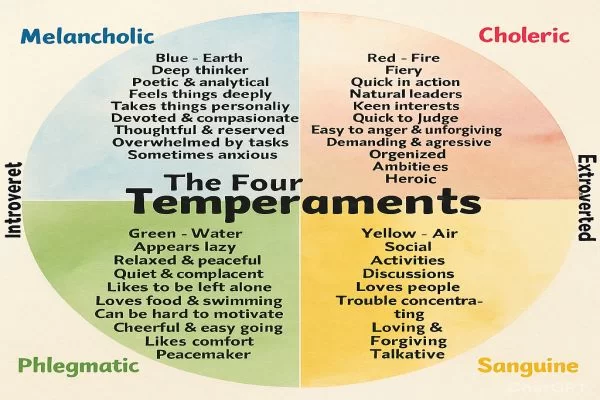
Below is a summarized chart showing the four temperament types and their dominant personality characteristics.
Origins of the Four Temperament Theory
The four temperament theory didn’t emerge overnight. It evolved over centuries from ancient Greek theories about the four elements, through the humoral theory of medicine, and later formalized by Galen into the four temperaments we know today.
The Four Elements Theory (Empedocles)
In the mid-5th century BCE, Empedocles first proposed the four elements theory, which became a strong philosophical basis for later four temperament theory. His macrocosmic theory describes four elements (earth, water, air, and fire) using four qualities (dry, wet, cold, and hot, respectively).1Heineman, P. L. (n.d.). History of temperament and temperament theory. Personality Project. Retrieved September 18, 2025, from https://personality-project.org/others/heineman/HISTORY.HTM
The Greek Hylozoists
In the next phase, Greek hylozoists like Anaxagoras, Democritus, and Alcmeon, etc, sought to attribute the cause of illness to material causes, matter, and humor. Anaxagoras suggested that health and disease were consequent on a mixture or imbalance of certain fundamental substances.
Democritus argued that this was a result of disturbances in the arrangement of atoms within the body, while Alcmeon (sometimes regarded as the early father of Greek medicine before Hippocrates) proposed that health is a balance of opposites (hot vs cold, wet vs dry), and disease is caused by an imbalance.
The Humoral Theory (Polybos)
In the 4th century BCE, Polybos, son-in-law to Hippocrates, consolidated the earlier theories by stating that there are four body humors (blood, phlegm, yellow bile, and black bile), and that their balance or imbalance reflects the body’s state of health. By implication, discomfort and pain result from either a deficiency or excess of any one or combination of these bodily fluids.2Ibid. Heineman
Each humor or body fluid differs from the others in color, texture, temperature, and degree of dryness or moisture. Blood was described as hot and moist, originating from the liver. Phlegm was cold and moist, from the lungs. Yellow bile was hot and dry, from the spleen, while black bile was cold and dry, originating from the gallbladder.
Hippocrates’ Contribution
Later in the 4th century BCE, Hippocrates, in his book “The Nature of Man (Peri physios anthropou)”, unified and expanded these ideas into a practical system of diagnosis and treatment of disease, a system that remained foundational to modern medicine as it is practiced today. He proposed that by modifying diet, environment, and lifestyle, we can restore balance to the body’s humors and, in turn, health.3Paei.wikidot.com. Hippocrates & Galen: The four humors. Retrieved September 25, 2025, from http://paei.wikidot.com/hippocrates-galen-the-four-humors
Hippocrates also used the four humors theory to describe people’s predominant temperament in health and disease, noting that when one humor is in excess, it can cause physical illness while also affecting a person’s disposition, mood, or temperament.
Galen’s Formalization
Galen (130-200A.D.), a Greek physician and student of Hippocrates, further formalized and popularized the four temperament theory in his treatise, Pericraison, de temperamentis, by explaining that there could be four kinds of healthy equilibrium instead of one balanced state and several abnormal states. These were the four temperaments: sanguine, phlegmatic, choleric, and melancholic.
Galen’s treatise on the four temperament theory was so well formulated that it remained the standard authority in medicine until the 16th century, after which physicians like Andreas Vesalius and, later, William Harvey shifted its application towards a more mechanistic approach involving blood, circulation, anatomy, and physiology through their medical discoveries.
The Four Temperaments
Here, we discuss in detail the temperament types in the four temperament theory. These are derived from the four bodily humors and also correspond to the four Empedoclean elements as earlier discussed.
1. Sanguine: Traits, Strengths & Weaknesses
The sanguine temperament is derived from the humor, blood. It corresponds with the Empedoclean element of ‘air’ and its qualities are described as hot and moist. According to Galen’s classification, sanguine is characterized by amorous, happy, generous, carefree, and optimistic personality traits.
Sanguines are naturally people-oriented; that is, they draw energy from being around people. They thrive in groups of supportive friends, love conversations, and build relationships quickly.
The sanguine is by far the most versatile and extroverted of the four temperaments, and they like to participate in or change their environment, making them some of the strongest change agents and influences in their environment. They are fun-loving, playful, activity-prone, impulsive, entertaining, persuasive, easily amused, and optimistic. They could be described as enthusiastic and expressive, often expressing themselves openly in an exciting manner, making them easily acceptable, approachable, and trusted by others.
Sanguines are wordsmiths. They will smile and talk easily without any pressure about what to say. Even when they enter the conversation midway, they soon take over the trajectory of the conversation going forward. This is because of how they express enthusiasm in what they say.
When telling a story, a sanguine person often exaggerates what happened or leaves out important details to make the story more exciting. To them, the facts do not matter much unless they make the moment more exciting.
Sanguines fear rejection or not being able to make an impression, and enjoy dressing according to current trends to feel in. They also fear being viewed as unsuccessful and would do what they can to stay in the limelight.
Sanguines are highly emotionally labile, demonstrating the widest range of emotions within the shortest possible time. They have quick highs and quick lows–can be bubbling with laughter one moment and then frustrated or discouraged the next, but they usually bounce back just as quickly. If something new catches their attention, their mood can change instantly, especially if it involves being around people. Thus, they tend to be disorganized and easily forget where they left something.
Sanguines get so involved in conversations that they easily forget about time and are often late for meetings and destinations. They are easily bored when in an activity that does not involve much social interaction, often disliking solitude. And when in such an event or activity, their focus, attention, or interest can change the very instant they become bored.
Sanguines are also very competitive, often because of their natural desire to be active, involved with people, and be in the limelight. They like sports of any kind, but they may choose their sports carefully, often preferring those that put them in an active position in the group.
Strengths of the Sanguine
- People-oriented → warm, friendly, and easily connects with others.
- Charismatic & persuasive → natural charm, makes people feel valued.
- Optimistic & positive → sees the bright side, encourages others.
- Fun-loving & entertaining → life of the party, brings joy to groups.
- Expressive & enthusiastic → animated communication, inspiring energy.
- Adaptable & versatile → can fit into many roles and situations.
- Storytelling ability → engaging, humorous, and creative.
- Forgiving & quick to forget → doesn’t hold grudges, moves on easily.
- Encouraging & motivating → uplifts others, spreads good morale.
Weaknesses of the Sanguine
- Emotionally labile → mood swings, easily distracted by feelings.
- Disorganized → forgetful, messy, poor with details and follow-through.
- Impulsive → acts before thinking, easily sidetracked.
- Exaggerates → may distort facts in storytelling for effect.
- Attention-seeking → craves approval and affirmation constantly.
- Easily bored → struggles with routines or long-term focus.
- Lack of depth → emotions are real but often shallow or short-lived.
- Poor time management → often late, loses track of commitments.
- Can be unreliable → starts things enthusiastically but doesn’t always finish.
2. Choleric: Traits, Strengths & Weaknesses
Choleric temperament is derived from yellow bile and represents the element of ‘fire’. Its qualities are described as hot and dry, with violent, vengeful, volatile, and ambitious personality traits. Individuals who have this primary temperament express behaviors in keeping with these traits.
The choleric is the least occurring of the four temperaments, and a female choleric is extremely rare. Cholerics are naturally result-oriented and play an active role in causing change even in an antagonistic environment. In other words, they seek to influence their environment and overcome opposition to get results.
You could describe a choleric as extroverted, fast-thinking, proactive, strong-willed, and easily annoyed. They are also practical, direct, straight to the point, and firm when communicating with others.
Cholerics find it easy to make group decisions and see the plan ahead of those around them, but they may be strongly opinionated and may leave little or no room for negotiation.
Cholerics like pressure and are well-adapted to work under pressure, primarily because they don’t see opposition when they want to achieve anything. By being result-oriented, they are easily bored when things are not happening fast enough.
Due to their desire to cause positive change in their environment, cholerics seek to be in control; they are domineering, self-sufficient, self-confident, and highly independent, making them great leaders. But when they seek control, it’s often not because they want to dominate or enslave others, but rather because they know their own ability to lead and cause change.
Cholerics are visionaries and seem to never run out of ideas, plans, and goals. Even when they feel stuck, they are always looking for a way to regain themselves. They do not see themselves as requiring much sleep like other people, and when they rest, it is because they want to regain energy for the next course of activity.
Cholerics usually do not care so much about what others think. They are only interested in achieving their goals, and they think big, too. They can be crusaders against social injustice or any cause that involves challenging the status quo.
They are slow to build relationships and tend to have only a few close friends. This is because they consider results to be more important than numerous acquaintances. They do not easily empathize with the feelings of others or show compassion.
Choleric individuals tend not to be angry, but their assertiveness and strong determination to get results may be interpreted as anger. They can be quickly aroused but also quickly calmed.
Strengths of the Choleric
- Natural leader → decisive, confident, and assertive.
- Goal-oriented → thrives on achievement and getting results.
- Efficient & practical → focuses on solutions, cuts out distractions.
- Strong-willed → determined, persistent, and doesn’t give up easily.
- Independent → self-sufficient, doesn’t need much external validation.
- Courageous → willing to take risks, confront challenges head-on.
- Organized & structured → good at planning, delegating, and directing.
- Persuasive → can influence others with authority and confidence.
- Productive → high energy for work and projects.
- Competitive → driven to win and excel.
- Resilient → can perform under pressure.
Weaknesses of the Choleric
- Domineering → can be bossy, controlling, and unwilling to listen.
- Insensitive → struggles with empathy and compassion for others’ feelings.
- Quick-tempered → prone to anger, impatience, and irritability.
- Stubborn → resists change or admitting they’re wrong.
- Impatient → wants instant results, dislikes delays or inefficiency.
- Workaholic tendencies → can over-prioritize tasks over relationships.
- Argumentative → enjoys debates, may come across as aggressive.
- Prideful → confident to the point of arrogance or dismissiveness.
- Poor listener → more interested in giving orders than hearing others.
- Can intimidate others → their intensity may push people away.
3. Melancholic: Traits, Strengths & Weaknesses
The melancholic temperament is derived from the black bile humor and represents the element of ‘earth’. Its personality traits are described as cold and dry–introspective, sentimental, and apathetic.
The melancholics are conscientious and perfectionistic, always wanting to do things right or in a certain way. They are quality– or detail-oriented, which means they just want to achieve a certain quality or level of perfection that others may see as unnecessary. They can also be sensitive to what others think of their work.
Melancholics are introverted (the most introverted of the four temperaments), logical, and analytical in their communication, looking for facts rather than sentiments. When they argue, it is not because they want to make you feel bad or assert dominance, but because they find it hard to take in just any information.
They hold grudges for a long time because they believe that those who hurt them are not likely to repent or change, from hurting them again or not meet their standards.
Melancholics are also stubborn and dogmatic about new behavioral trends, often holding firm to their carefully thought-out views rather than going with the flow. They influence their immediate environment by adhering to the existing rules and doing things right according to pre-existing standards.
They are determined to make the right and best decision, so they will take time to collect lots of information, ask specific questions, and sometimes ask the same question several times for the sake of clarity. After spending a lot of time thinking about their available options, they may still be unsure if that is the right and best decision.
Melancholics respond to situations in a slow, cautious, and indirect manner. They are reserved and suspicious until they are sure of your intentions. They try to probe for the hidden meaning behind your words and actions, making them appear timid, unsure, and too serious.
Melancholics are very pessimistic, assuming the worst from the onset. They have anxiety about the present and the future, with tendencies to have guilt feelings without easily realizing that guilt or worry will not change the past or the future.
Melancholics are highly organized. They like to keep things in perfect condition, but when they keep things cluttered, they will know what is in the piles. They are gifted and creative, but they can be moody, reserved, and isolated, and this is usually related to their fear of negative evaluation from other people.
Strengths of the Melancholic
- Deep thinker → analytical, reflective, and detail-oriented.
- Serious and purposeful → takes life and responsibilities seriously.
- Perfectionist → strives for accuracy, quality, and excellence.
- Organized and structured → likes order, planning, and precision.
- Conscientious → reliable, thorough, and careful.
- Loyal and faithful → strong commitment to relationships and duties.
- Compassionate and empathetic → sensitive to others’ pain and needs.
- Creative and artistic → often gifted in music, art, and writing.
- Self-disciplined → can stick to tasks and complete them with focus.
- Principled → guided by strong values and integrity.
Weaknesses of the Melancholic
- Overly critical → hard on themselves and others.
- Perfectionism → sets unrealistically high standards, easily discouraged.
- Pessimistic → tends to see problems or expect the worst.
- Introverted and withdrawn → may isolate themselves when hurt or stressed.
- Sensitive to criticism → easily wounded by harsh words or rejection.
- Indecisive → struggles to make decisions for fear of making mistakes.
- Moody → prone to sadness, worry, and depression.
- Overly cautious → hesitant to take risks or try new things.
- Stubborn in ideals → may hold tightly to views or standards.
- Prone to guilt and self-blame → struggles with letting go of failures.
4. Phlegmatic: Traits, Strengths & Weaknesses
The phlegmatic temperament is derived from phlegm, representing the element of ‘water’. Its qualities are hot and moist, and primarily phlegmatic people have the personality traits of being amorous, happy, generous, carefree, and optimistic.
Phlegmatics are naturally service-oriented; that is, quietly contributing and influencing their environment through cooperation rather than through leadership or emotional display.
Phlegmatics can be described as calm and introverted, preferring to live a quiet and routine, private, and low-key lifestyle centred around home and family, rather than getting too involved in dynamic/spontaneous activities or with too many different people. If they want to hang out with friends, they enjoy the company of a few selected friends.
They display possessiveness in their friendships and material things. They are loyal to their few friends and find it difficult to break long-standing relationships regardless of what the other person does or doesn’t do. However, once a relationship is broken, they seldom return.
Phlegmatics tend not to be highly ambitious. They seldom exert themselves or push their way along in their career or profession, and they prefer just to let things happen of their own accord. They are passive in both favorable and unfavorable conditions, and tend to lack a sense of urgency in their activities.
Phlegmatics are often indecisive, patient, and agreeable, making them good team players. They readily submit to the choices of other people in making their decisions. They are naturally unable to imagine themselves assuming a leadership role and would prefer to work as a follower, as long as you don’t try to alter their routine lifestyle.
They are not so concerned with perfectionism; they are not picky, and they do not judge others quickly. Their cool-headed and submissive nature makes them yield to people’s insistence rather than try to assert themselves. They wish for peace and would do anything to avoid conflict, even if it means discomfort.
Phlegmatics are often opposed to change. They might take time to adjust when they encounter a sudden change in their routine. They also resist making rash decisions. They are practical, concrete, and traditional thinkers.
They hold a grudge because they are inwardly sensitive. Even though they don’t explode, the offense can linger in their mind. And because they appear calm, others may assume Phlegmatics forgive easily, but in reality, true forgiveness may take them a long time.
Strengths of the Phlegmatic
- Calm and peaceful → they remain steady under pressure and rarely lose their cool.
- Diplomatic and peacemaking → naturally able to mediate conflicts and bring harmony.
- Dependable and consistent → others can rely on them to show up and follow through.
- Patient and tolerant → willing to wait and give people time without getting frustrated.
- Loyal and steady in relationships → once they commit, they stick around.
- Good listeners → they take time to hear others out and don’t rush to respond.
- Easy-going and agreeable → flexible and not easily upset by inconveniences.
- Service-oriented → often willing to help and support others without demanding attention.
Weaknesses of the Phlegmatic
- Avoids confrontation → may suppress issues instead of addressing them, leading to hidden resentment.
- Indecisive or hesitant → struggles with taking initiative or making quick choices.
- Resistant to change → prefers routines and can be slow to adapt to new situations.
- Procrastinates → tends to delay action until pushed.
- Unassertive → may let others dominate them or fail to express their true feelings.
- Can hold grudges quietly → appears forgiving but may carry resentment internally.
- Passive-aggressive tendencies → instead of saying “no,” they may agree outwardly but resist subtly.
- Lacks ambition or drive → content with stability, which can sometimes look like laziness.
Now that you understand the four temperament types, take the free temperament test to see how strongly you relate to each one
Modern Views of the Temperament Theory
Several modifications of the four temperament theory have existed over time, including the following:
1. Modification based on intensity level
In this modification, there are at least three levels of intensity of any of the four primary temperaments–mild, moderate, and classical/strong. This sub-classification is based on the degree of classical traits of the primary temperament in the individual.
For example, a person could be a mild Sanguine (outgoing but not overly talkative) or a strong Choleric (highly dominant and assertive).
2. Blended Temperaments
This model proposes that most people are not 100% one temperament. That is, there is a blend between more than one temperament. For example, Sanguine-Choleric or Melancholic-Phlegmatic, where the first is the primary temperament and the second is the secondary temperament.
This concept of blended temperament makes the four temperament theory more flexible and realistic, since pure temperaments are rare.
3. Temperaments with Secondary Influences
Another modern view about the four temperaments posits that while we may have a predominant primary temperament, secondary influences like environment, culture, faith, and experience can shape how it is expressed. For example, a naturally Choleric child raised in a gentle, non-confrontational family may learn to soften their approach.
This model is also more realistic and flexible since it acknowledges that most people do not have a pure primary temperament.
4. Link with Modern Personality Theories
Two modern personality models that may have been adapted from the four temperament theory include the Myers-Briggs (MBTI) and the Big Five Traits. The MBTI classifies people into 16 personality types, totally absorbing the five temperament traits into several domains. Examples of the personality types in the MBTI classification include ENTJ, ESTJ, ENFP, and ESFP, and a choleric may fit into ENTJ/ESTJ, while a Sanguine may fall within ENFP/ESFP.
In the Big Five Traits classification, five traits are used to define each of the primary temperaments. These traits are Openness, Conscientiousness, Extraversion, Agreeableness, and Neuroticism (often remembered by the acronym OCEAN), and the four primary temperaments are defined as follows:
- Sanguine → High Extraversion, Low Neuroticism.
- Choleric → High Extraversion, High Assertiveness.
- Melancholic → High Neuroticism, High Conscientiousness.
- Phlegmatic → High Agreeableness, Low Neuroticism.
5. Christian/Spiritual Modifications
The Christian/Spiritual modifications of the primary temperaments, proposed by Tim LaHaye, Florence Littauer, etc, reframed the temperaments not as destiny, but as a tool for self-improvement.4DhaivatPatel. Five Temperaments [PDF]. Scribd. Retrieved September 28, 2025, from https://www.scribd.com/document/94963949/Five-Temperament. Thus, by understanding one’s inherent temperamental weaknesses, one can train or refine them while building strength concomitantly. This emphasizes that temperaments can be influenced by spiritual growth.
6. The Ultimate Temperament
In line with the Christian Modification of the four temperaments, I coined a fifth temperament known as the Ultimate Temperament, which is a blend of all four temperaments. This new temperament is dynamic, focusing on constant self-improvement to suppress weaknesses, build strength, and adopt strengths from the other primary temperaments.
While literature already talks about the Supine temperament in the five temperament theory, I describe the Ultimate Temperament as a conscious blend of as many strengths as possible, while down-tuning the weaknesses in one’s primary temperament. This, I call the Ultimate Temperament.
Frequently Asked Questions
What's the difference between temperament and personality?
Temperament is different from personality in the sense that while temperament is the innate, biological foundation of behaviour present from birth, personality is shaped by temperament combined with environment, upbringing, and experience over time.
Can someone have more than one temperament?
Yes. Most people are a blend of a primary and secondary temperament (e.g., Sanguine-Choleric), rather than a single "pure" type. This gave birth to the idea of the blended temperament.
What is a temperamental person?
Temperamental is a term used casually to describe someone prone to unpredictable mood swings. It is most closely associated with the Sanguine or Melancholic temperament types, whose moods change easily, but its usage relates less to the formal psychology of the four temperaments.
Final Words
The four temperament theory describes human predominant attitudes and how we respond to our immediate environment. Understanding your own temperament and the other people around you can genuinely change how you communicate, work, and build relationships.
Take the free Temperament Test above to find your exact primary and secondary type, see your personalized strengths and blind spots, and get a shareable result card. It takes about 5-7 minutes in total.
If you’d rather keep a quick reference of this concept, you can also download the strengths and weaknesses summary as a PDF here.
If you found this guide helpful, share it with someone who’d enjoy discovering their own type, and let me know in the comments which temperament you turned out to be.
References
| ↑1 | Heineman, P. L. (n.d.). History of temperament and temperament theory. Personality Project. Retrieved September 18, 2025, from https://personality-project.org/others/heineman/HISTORY.HTM |
|---|---|
| ↑2 | Ibid. Heineman |
| ↑3 | Paei.wikidot.com. Hippocrates & Galen: The four humors. Retrieved September 25, 2025, from http://paei.wikidot.com/hippocrates-galen-the-four-humors |
| ↑4 | DhaivatPatel. Five Temperaments [PDF]. Scribd. Retrieved September 28, 2025, from https://www.scribd.com/document/94963949/Five-Temperament |














You Might Also Like