
While contraceptives remain the mainstay of preventing unintended pregnancy before or after sexual intercourse, some people like to find ways to avoid pregnancy via natural means. This may be due to personal reasons, religious beliefs, or the awareness of certain side effects from some contraceptive use.
Timing is important in preventing pregnancy naturally, which is why many people are now trying to discover the best time to have unprotected sex without getting pregnant. If you are such a person looking for that time or day when it is safe to have sex without getting pregnant, this post is all you need.
You also need to understand how it works, the risks, safety, effectiveness/failure, and precautions to take when applying timing in the prevention of pregnancy with unprotected sexual intercourse. These will also be discussed in this post.
Best Time to Have Sex Without Getting Pregnant
There is no safe period for unprotected sex without getting pregnant. However, a woman’s fertility or ease of getting pregnant is not the same throughout her cycle.
Getting pregnant requires several hormonal and physiological changes, as well as the presence of viable male and female gametes (sperm and ovum, respectively), whose interaction after sexual intercourse results in pregnancy.
Thus, the best time to have unprotected sex with a partner with the least chances of pregnancy should coincide with the period in a woman’s cycle with the lowest chances of interaction between the man’s sperm and the woman’s ovum. This is the basis of the safe period concept, which emphasizes the safest period in a woman’s cycle when a mature egg or ovum is not available for fertilization and conception.
When is the Safe Period for Sex?
Knowing the safe period to have sex with your partner without getting pregnant requires a good understanding of the menstrual cycle. This cycle gives a near-accurate depiction of what is happening inside a woman’s body every month, regarding her fertility or otherwise.
By carefully calculating the woman’s menstrual cycle, you can know the safe period for sex, but this is not foolproof, as you will see shortly.
A woman’s most fertile period is around the middle of her menstrual period. This corresponds to the ovulation period, during which a mature egg, or ovum, is released from the ovary into the fallopian tube, where it interacts with a viable sperm cell for fertilization and conception. Periods away from this mid-cycle are relatively safer for sex if you don’t want to get pregnant.
The Menstrual Cycle

The first day of menstruation is day 1 of the menstrual cycle, and the day just before the resumption of another menstrual period (menstruation) is the last day of the cycle. For most women, the entire cycle lasts 28 days; for others, more or less. The normal cycle length ranges from 21 days to 35 days. Anything outside this is considered abnormal.1Watson, S. (2025, April 23). Understanding your menstrual cycle. Everyday Health. https://www.everydayhealth.com/womens-health/understanding-your-menstrual-cycle/
Ovulation takes place on day 14 before the beginning of the next cycle, irrespective of the cycle length. Days 12 to 16 are known as the ovulation period or peri-ovulation period, and are the most fertile days in a woman’s cycle. Avoid sex during this time or use a barrier contraceptive if you don’t want to get pregnant during this time.
Day 1 to 7 corresponds to the menstrual period when a woman sees her menses. The normal period length ranges from 2 to 7 days. Thus, if a woman bleeds for less than 2 days or more than 7 days, it is considered abnormal, which means there may be some problems in her menstrual or reproductive cycle.
This information on the menstrual cycle can help you time when it is safest to have sex without getting pregnant, as you will see in the next section.
How to Calculate Your Safe Period for Sex
To calculate when it is relatively safe to have sex, the Calendar Rhythm method, the fertility awareness method, or simply the Rhythm method is often used. This method is fairly accurate, assuming a woman knows her cycle length over a period of time.2Mayo Clinic. Rhythm method. Mayo Foundation for Medical Education and Research. May 2022. https://www.mayoclinic.org/tests-procedures/rhythm-method/about/pac-20390918
Though it has gradually been replaced by newer methods of contraception, the rhythm method has been around for some time now and is still effective. The Standard Days method is a modern modification of the rhythm method and works best if a woman’s menstrual cycles are between 26 and 32 days long.
Using the Standard Days method,
- Days 1-7: Not fertile
- Days 8-19: Fertile
- Days 20-last day: Not fertile
While the Standard Days method is based on the standard cycle length between 26 to 32 days, the simple Calendar Rhythm method helps you specifically determine your safe period based on your cycle length. Here is how to calculate.
- Using a calendar, record the length of six to twelve of your menstrual cycles, with day 1 being the first day of menses and the last day being the day before the next menses.
- Subtract 18 from the total number of days in your shortest cycle. This number represents the first fertile day of your cycle.
- Subtract 11 from the total number of days in your longest cycle. This number represents the last fertile day of your cycle.
- Continue recording the length of your menstrual cycles to make sure you are properly determining your fertile days.
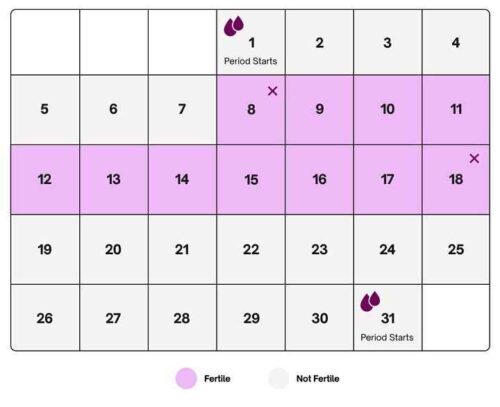
Custom infographic or calendar visual explaining safe/unsafe days
Example:
If your shortest menstrual cycle over 6 months is 26 days, the first fertile day = 26 – 18, which equals 8 (corresponding to the 8th day of your cycle). If your longest menstrual cycle is 32 days, the last fertile day = 32 – 11, which equals 21 (corresponding to the 21st day of your cycle). Thus, your fertile period will be between days 8 to 21.
Safe Period Calculator
Failure Rates of the Rhythm Method
The rhythm method is not foolproof based on the idea that there is no absolutely safe period in a woman’s cycle. Wrong calculations and non-avoidance of sex during calculated fertile periods can increase the failure rates of the rhythm method.
According to the Cleveland Clinic, the rhythm method is effective 75% of the time.3Cleveland Clinic. Rhythm method. Cleveland Clinic. March 2023. https://my.clevelandclinic.org/health/articles/17900-rhythm-method Another study showed a failure rate over 12 months of 11%4Burkhart, Marianne C., Lidia de Mazariegos, Sandra Salazar, and Virginia M. Lamprecht. “Effectiveness of a Standard‑Rule Method of Calendar Rhythm Among Mayan Couples in Guatemala.” International Family Planning Perspectives, vol. 26, no. 3, Sept. 2000, pp. 131–136. Guttmacher Institute, www.guttmacher.org/journals/ipsrh/2000/effectiveness-standard-rule-method-calendar-rhythm-among-mayan-couples (conversely, 79% effectiveness) for typical users and 5%5Wikipedia contributors. Comparison of Birth Control Methods. Wikipedia, The Free Encyclopedia, 17 July 2025, https://en.wikipedia.org/wiki/Comparison_of_birth_control_methods. (95% effectiveness for perfect users).
Considering that this method is based on estimations from past cycle lengths, it is unreliable as period lengths can change at any point due to stress, medications, hormonal changes, or other factors.
Lastly, it is important to note that ejaculated spermatozoa can remain viable in the woman’s genital tract for up to 5 days. The ovum can stay viable for 12 to 24 hours after ovulation. Thus, while you may have had sex on a supposed ‘safe period’, the sperm may stay active to fertilize the ovum released a few days later, making the belief in an absolute safe period only a mirage.6UCSF Center for Reproductive Health. How Conception Works. UCSF, accessed July 21, 2025. https://crh.ucsf.edu/about-fertility/conception
Signs That You Are Fertile
In contrast to the safest time when a woman is not likely to get pregnant after unprotected sex, the fertile period is the time when a woman is most likely to conceive. This corresponds to just about a week before and after ovulation (day 14).
The following are some signs that indicate when a woman is ovulating or about to, depicting her most fertile period of the menstrual cycle.
- Increase basal body temperature by 1-2°C
- Mild cramps or mittelschmerz (German for mid-cycle pain)
- Thinning and increased stretchiness of the cervical mucus
- Heightened sense of smell
- Tenderness/pain on the breast
- Increased libido
Irrespective of your calculation for the safe period, these signs indicate when you are most fertile as a woman.
Precautions of the Safe Period (Rhythm) Method
To ensure optimal effectiveness of the Calendar Rhythm method, these are some precautions to consider.
- Track your menstrual period accurately for at least 6-12 months.
- Avoid sex during the fertile window shown above.
- Ensure that your cycle is regular (within 28 ± 7 days).
- Know the signs of fertility and avoid sex during this time.
- Avoid using the rhythm method when ill or stressed, as these conditions can interfere with the cycle.
- Use a condom if you also want to protect against STIs, as the Calendar method does not provide any protection against sexually transmitted infections.
- Both partners should be committed and disciplined when using this method.
- Know the failure rates and prepare for any uncertainty.
More Reliable Alternatives to the Safe Period Method
If you are not constrained by your religious beliefs or personal convictions, there are more reliable contraceptive methods you could use instead of the Calendar Rhythm method. These methods are more effective at preventing pregnancy.7World Health Organization. Family Planning/Contraception: Key Facts. World Health Organization, accessed July 21, 2025. https://www.who.int/news-room/fact-sheets/detail/family-planning-contraception.
- Barrier contraceptives, e.g., male condom, female condom, diaphragm, and cervical caps
- Hormonal pills
- Injectables
- Implants
- Emergency contraceptives, e.g., Contraceptive pills and intrauterine devices (IUCDs)
- Permanent surgical contraception, e.g., tubal ligation and vasectomy.
Common emergency contraceptive pills are Levonorgestrel (Postinor®) and Ulipristal acetate. These hormonal pills can help prevent pregnancy after engaging in unprotected sexual intercourse during a fertile period, especially if taken within 72 hours and 5 days, respectively, after the intercourse.
Consult your doctor for the best method suitable for you and your partner.
Frequently Asked Questions
Final words
While there is no absolute safe period to have unprotected sex without getting pregnant, the rhythm method helps partners and couples plan sex on periods of the woman’s cycle with the least likelihood of conception. This post has explored all you need to know about the safe period and how to calculate your safe period as a woman.
If you have further comments or questions, drop them in the comment section below. Otherwise, I’d appreciate your kind words and a share.
References
| ↑1 | Watson, S. (2025, April 23). Understanding your menstrual cycle. Everyday Health. https://www.everydayhealth.com/womens-health/understanding-your-menstrual-cycle/ |
|---|---|
| ↑2 | Mayo Clinic. Rhythm method. Mayo Foundation for Medical Education and Research. May 2022. https://www.mayoclinic.org/tests-procedures/rhythm-method/about/pac-20390918 |
| ↑3 | Cleveland Clinic. Rhythm method. Cleveland Clinic. March 2023. https://my.clevelandclinic.org/health/articles/17900-rhythm-method |
| ↑4 | Burkhart, Marianne C., Lidia de Mazariegos, Sandra Salazar, and Virginia M. Lamprecht. “Effectiveness of a Standard‑Rule Method of Calendar Rhythm Among Mayan Couples in Guatemala.” International Family Planning Perspectives, vol. 26, no. 3, Sept. 2000, pp. 131–136. Guttmacher Institute, www.guttmacher.org/journals/ipsrh/2000/effectiveness-standard-rule-method-calendar-rhythm-among-mayan-couples |
| ↑5 | Wikipedia contributors. Comparison of Birth Control Methods. Wikipedia, The Free Encyclopedia, 17 July 2025, https://en.wikipedia.org/wiki/Comparison_of_birth_control_methods. |
| ↑6 | UCSF Center for Reproductive Health. How Conception Works. UCSF, accessed July 21, 2025. https://crh.ucsf.edu/about-fertility/conception |
| ↑7 | World Health Organization. Family Planning/Contraception: Key Facts. World Health Organization, accessed July 21, 2025. https://www.who.int/news-room/fact-sheets/detail/family-planning-contraception. |













You Might Also Like