
Ever since I came across cockroach milk and learned that it is considered the most nutritious milk ever, I have become fascinated by this new type of nourishment. Cockroaches or any of their products have never had any good reputations in my books.
I have always known cockroaches as those stinking insects that feed on feces and decaying materials. They are also carriers of the micro-organism that causes leprosy and other diseases. This was why I was extremely shocked when I first heard that some Asian countries consider this insect a sumptuous delicacy.
It wasn’t too long after that discovery that I stumbled across a social media post describing cockroach milk as one of the most nutritious substances on Earth. A research-based study in 2018 also described cockroach milk as the next superfood.[1]Niaz K, Zaplatic E, Spoor J. Highlight report: Diploptera functata (cockroach) milk as next superfood. EXCLI J. 2018
And if, like me, you are still wondering how the same roaches we all know have become such a valuable insect, here is everything you need to know about cockroach milk and its nutritional value.
What is Cockroach Milk?
Unlike mammals, cockroaches do not have specialized mammary glands (breasts) where they produce milk to feed their young. There are currently 4600 species of cockroaches and over 460 genera. Of these, only about four widespread species are commonly regarded as pests,[2]Cockroach. (Updated 2025, January 14). In Wikipedia. and only one species (Diploptera functata) give birth to live offspring instead of laying eggs.[3]Ibid., Niaz et al., EXCLI J. 2018
Diploptera functata (D. functata) is called the Pacific beetle mimic cockroach due to its resemblance to members of the beetle families. It also shares significant resemblance with other cockroach species, differing majorly in its ability to give birth to live young ones and produce the now famous “Cockroach milk“.[4]Genome Spotlight: Pacific Beetle-Mimic Cockroach (Diploptera punctata) – The Scientist

Cockroach milk is a crystalline substance secreted from the walls of the brood sac of the pregnant cockroach. This brood sac is a uterus-like cavity in the insect’s abdomen that houses the young cockroaches before they are born alive. The growing cockroaches consume this crystalline milk until they emerge from the sac as fully-formed insects, at which time they no longer rely on the milk while the milk-secreting glands get obliterated.[5]Ibid., The Scientist
The milk is typically extracted from the cockroach’s midgut. The lactating insect, housing 12 fertilized embryos in its brood sac is first killed, the embryos gently removed, and the midgut separated by cutting off the head and the end of the abdomen. The following video shows how the crystals are extracted from the isolated midgut.[6]Sanchari Banerjee, et al. Structure of a heterogeneous, glycosylated, lipid-bound, in vivo-grown protein crystal at atomic resolution from the viviparous cockroach Diploptera punctata. IUCr
However, the process is highly labor-intensive requiring a large number of pregnant cockroaches to produce a significant amount of milk, Chavas, a co-researcher at the International Union of Crystallography stated. An estimated 1,000 cockroaches would be killed to extract only 100 grams of cockroach milk, a process that is not feasible for the large-scale production of consumable quantities of milk.[7]What the Hell Is Cockroach Milk Anyways? – Inverse
Nutritional Composition of Cockroach Milk
The cockroach milk is highly rich in essential nutrients such as oleic acid, omega-3 fatty acids, short and medium-chained fatty acids, minerals, essential proteins, etc. It has been found to contain all the essential amino acids, and up to three times more calories than cow milk.[8]Ibid., Sanchari et al. IUCr
Extracted cockroach milk has been found to contain 45% protein, 5% amino acids, 25% carbohydrate, and 16 to 22% lipid. All common amino acids were present in hydrolyzed protein and as free amino acids, with glutamate and aspartate as the most abundant amino acids. Carbohydrates include 4 free sugars and protein-bound sugars, with the most abundant being mannose. Linoleic acid and Oleic acid were the most abundant lipids.[9]M.J. Ingram, B. Stay, G.D. Cain. Composition of milk from the viviparous cockroach, Diploptera punctata, Insect Biochemistry.[10]Ibid., IUCr
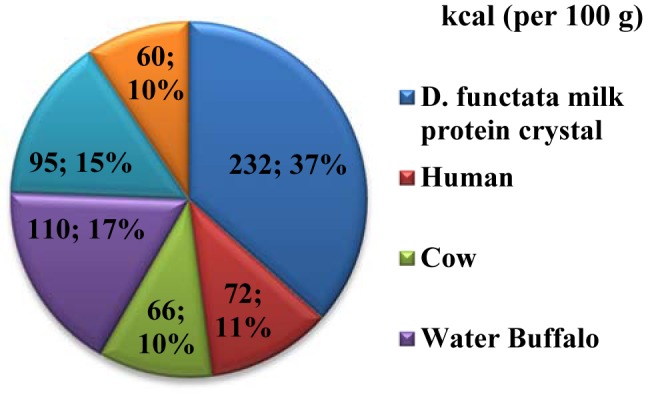
Compared to other sources of milk, cockroach milk has about 4 times the calories of cow milk and 3 times that of human milk, a study reports (as shown in the chart below). This further lends credibility to the fact that cockroach milk is probably the most nutritious milk ever.
Benefits of Cockroach Milk
Due to its rich content of high-quality proteins, calories, and lipids, cockroach milk has the following potential benefits.
1. Enhanced growth, development, and bodybuilding
Proteins are regarded as the building blocks of the body but they make up every cell, tissue, or organ. The biomolecules are primary constituents of bone, muscle, nerves, blood, and other components of the body.
Cockroach milk being a rich source of essential amino acids (proteins) could potentially enhance the development of the body’s tissues as well as optimal metabolism and growth.
2. Detoxification
Cockroach milk is also a rich source of aspartate. Studies have shown that aspartate significantly helps in the detoxification of ammonia, a waste product produced by the body.[11]Holeček M. Aspartic Acid in Health and Disease. Nutrients. 2023 Sep 17
3. Boost sexual performance in men
Also being one of the most abundant amino acids in cockroach milk, aspartate has also been shown to increase testosterone levels. A study done in 2017 showed that aspartate could boost sexual performance and fertility in men through its effects in increasing testosterone levels.[12]Roshanzamir F, Safavi SM. The putative effects of D-Aspartic acid on blood testosterone levels: A systematic review. Int J Reprod Biomed. 2017 Jan;15(1)
4. Enhances memory and brain function
Glutamate is the most abundant amino acid in cockroach milk and it is regarded as an important neurotransmitter required for brain functioning. This can mean that cockroach milk would have the potential to enhance memory and optimal brain functioning.
5. Improves cardiovascular health
The American Heart Association published a study in 2009 showing the effects of glutamic acid and blood pressure; stating that it has a more significant effect in lowering blood pressure compared to other blood-pressure-lowering amino acids like cysteine, proline, phenylalanine, and serine.[13]Jeremiah Stamler, Ian J. Brown, Martha L. Daviglus, Queenie Chan, Hugo Kesteloot, Hirotsugu Ueshima, Liancheng Zhao, and Paul Elliott. Glutamic Acid, the Main Dietary Amino Acid, and Blood Pressure. … Continue reading This shows that cockroach milk will be beneficial to cardiovascular health due to the high amount of glutamate it contains.
6. Promotes gut health
Glutamate is a major substrate by intestinal cells, which promotes enterocyte proliferation, regulates tight junction proteins, suppresses pro-inflammatory pathways, and protects the intestinal cells against cellular stresses and apoptosis. Though it is found at high concentrations in cockroach milk, glutamate is not an essential amino and can be synthesized by the body.
Frequently Asked Questions
Is cockroach milk safe?
While cockroach milk has been dubbed the next super food, there is currently not enough scientific evidence that it is safe for human consumption. But it is also not known to contain harmful chemicals as well.
Is cockroach milk liquid milk?
Cockroach milk does not have any significant similarity with dairy milk or human milk. In stable form, it occurs as a crystalline substance that may be dissolved in an appropriate solvent. It does not naturally dissolve in water.
It is called milk because it is the early food of young cockroaches, similar to other forms of animal milk. It may however be processed into liquid form but it won’t exactly resemble traditional milk.
Is it the most nutritious milk?
Theoretically, yes. Cockroach milk is three times more nutritious than cow milk but there is no evidence that it can be safely consumed by humans. Also, the limitation in producing large quantities makes it an unfeasible source of consumable milk even if it were safe. Cow milk is still the most nutritious consumable milk currently.
Scientists are excited about the potential to use it to fortify common drinks like dairy milk and coffee, or in drug research. Maybe cockroach milk could find more usefulness in the future as more research unfolds in these areas.
How is cockroach milk produced?
Cockroach milk is extracted from the midgut of the pregnant beetle-mimic cockroach, D. functata. This substance is isolated and purified using special biochemical processes.
How does cockroach milk taste?
According to an Indian scientist who has studied it, Subramanian Ramaswamy, cockroach milk doesn’t taste like much; maybe pretty much like nothing. He further explained that it won’t make any difference in taste when added to any other food or drink.
How does cockroach milk smell?
Though cockroaches do have the characteristic musty, oily smell, cockroach milk does not have a strong flavor. It is also possible that the process of extraction and purification may also reduce the strong “Oleic acid smell” typical of cockroaches.
How much is cockroach milk?
The substance is currently not commercially available, and nothing is currently known about its cost. Extracted samples of cockroach milk are only being studied for their potential uses but are not being sold currently.
References
| ↑1 | Niaz K, Zaplatic E, Spoor J. Highlight report: Diploptera functata (cockroach) milk as next superfood. EXCLI J. 2018 |
|---|---|
| ↑2 | Cockroach. (Updated 2025, January 14). In Wikipedia. |
| ↑3 | Ibid., Niaz et al., EXCLI J. 2018 |
| ↑4 | Genome Spotlight: Pacific Beetle-Mimic Cockroach (Diploptera punctata) – The Scientist |
| ↑5 | Ibid., The Scientist |
| ↑6 | Sanchari Banerjee, et al. Structure of a heterogeneous, glycosylated, lipid-bound, in vivo-grown protein crystal at atomic resolution from the viviparous cockroach Diploptera punctata. IUCr |
| ↑7 | What the Hell Is Cockroach Milk Anyways? – Inverse |
| ↑8 | Ibid., Sanchari et al. IUCr |
| ↑9 | M.J. Ingram, B. Stay, G.D. Cain. Composition of milk from the viviparous cockroach, Diploptera punctata, Insect Biochemistry. |
| ↑10 | Ibid., IUCr |
| ↑11 | Holeček M. Aspartic Acid in Health and Disease. Nutrients. 2023 Sep 17 |
| ↑12 | Roshanzamir F, Safavi SM. The putative effects of D-Aspartic acid on blood testosterone levels: A systematic review. Int J Reprod Biomed. 2017 Jan;15(1) |
| ↑13 | Jeremiah Stamler, Ian J. Brown, Martha L. Daviglus, Queenie Chan, Hugo Kesteloot, Hirotsugu Ueshima, Liancheng Zhao, and Paul Elliott. Glutamic Acid, the Main Dietary Amino Acid, and Blood Pressure. Circulation. 2009 |












You Might Also Like