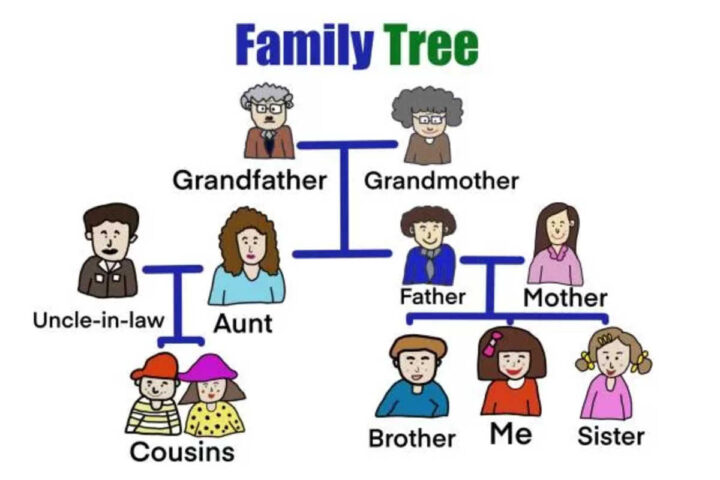
Cousin marriage, a form of consanguineous marriage, is a marriage between close relatives, up to second cousins. It’s a union between people who are related by blood. The practice has existed in many cultures for religious, political, and kinship reasons; however, its prevalence and level of acceptance vary across communities.1Cousin marriage. (2025, August 30). In Wikipedia. Retrieved August 30, 2025, from https://en.wikipedia.org/wiki/Cousin_marriage
Consanguineous marriage refers to a union between blood relatives, generally second cousins or closer, but it also includes other close-relative unions, such as uncle-niece marriages. While consanguineous or close-cousin marriage may offer some social benefits where it is practised, it also increases the risk of certain inherited disorders in children, some of which can be life-threatening.2Khayat A M, Alshareef B, Alharbi S F, et al. (February 09, 2024) Consanguineous Marriage and Its Association With Genetic Disorders in Saudi Arabia: A Review. Cureus 16(2): e53888. doi:10.7759/cureus.53888. The pros and cons deserve special attention, especially if you are planning to have children.
Thus, whether you are considering marrying a cousin or simply want to understand the practice, this article examines its reported benefits, potential disadvantages, and genetic risks to help you make an informed decision.
Pros and Cons of Cousin Marriage
The table below summarises reported social benefits and potential disadvantages. These outcomes vary between couples and communities; social benefits do not remove reproductive risks.
| Potential benefits | Potential disadvantages and risks |
|---|---|
| Familiarity with a partner and their family: An existing relationship may make family backgrounds better known, although it does not guarantee transparency. | Increased risk of certain inherited conditions: Related partners are more likely to carry the same disease-causing genetic variants. |
| Established family support: Familiar relatives and in-laws may help a couple adjust to married life. | Family pressure: Strong expectations to marry a cousin may limit freedom of choice. |
| Continuity of cultural traditions: Shared customs may be easier to maintain and pass on to children. | Wider family conflict: Marital disagreements or separation may strain relationships within the extended family. |
| Keeping property within the extended family: Some families favour cousin marriage to retain land, businesses, or inherited assets. | Possible reduction in birth weight: Some research has associated consanguinity with slightly lower birth weight for gestational age. |
Table showing the pros and cons of cousin marriage.
Difference Between First and Second Cousins
Your first cousins are the children of your aunt or uncle, meaning one of your parents is the other’s sibling, and you share grandparents. They are also referred to as first-order cousins and share about 12.5% of their DNA.3Genealogy Explained. (n.d.). How much DNA do first cousins share? https://www.genealogyexplained.com/how-much-dna-do-first-cousins-share/
Second cousins are children who share the same great-grandparents but not grandparents. Their parents are first cousins to each other, and their grandparents are siblings.
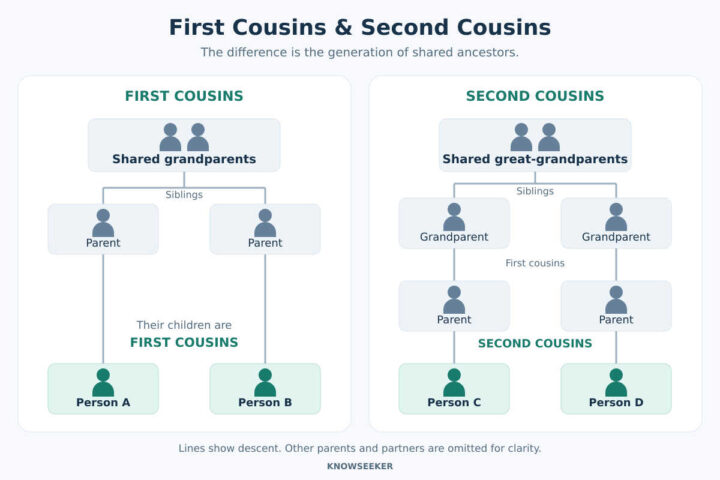
There are several orders of cousins, such as third-order, fourth-order, sixth-order, and beyond, but children of first-order cousin unions have the highest (4-6%) reproductive risks, including stillbirths, infant mortality, and birth defects. These risks generally decrease with higher-order cousin relationships, but an individual cousin-couple’s risk may also depend on their family history and whether they carry variants for an inherited condition.4Hamamy H. Consanguineous marriages: Preconception consultation in primary health care settings. J Community Genet. 2012 Jul;3(3):185-92. doi: 10.1007/s12687-011-0072-y. Epub 2011 Nov 22. PMID: 22109912; PMCID: PMC3419292.
Can First or Second Cousins Marry?
Marrying your first or second cousin is not inherently wrong, but this depends on your personal and religious beliefs, cultural expectations, and the marriage laws where you live. Some cultures and religious contexts may permit close cousin marriages, while others may not. Free consent from both individuals is also important.
Having children with a second cousin generally carries a lower additional genetic risk than having children with a first cousin. This may explain why some cultures condemn the practice. However, if you are considering marrying and having children with a first or second cousin, it can help to review your family history with a genetic counsellor to clarify the risks and whether additional testing would be required.
Potential Benefits of Cousin Marriage
Consanguineous marriage, of which cousin marriage is a type, has been practiced mainly due to social reasons. Notable individuals in history who married a close cousin include Charles and Emma Darwin (first cousins), Saddam Hussein and Sadija Talfah (first cousins), Albert Einstein and Elsa Lowenthal (first maternal cousins and second paternal cousins), Franklin and Eleanor Roosevelt (fifth cousins once removed)5”Once removed”; meaning separated by one generation. MyHeritage, and Thomas Jefferson and Martha Wayles Skelton (third cousins).
Here are some potential benefits of cousin marriage.
1. Better relationship between a partner and in-laws
One of the potential benefits of marrying a close cousin is that it sustains a cordial relationship between a partner and in-laws. This was also in keeping with a Pakistani study on consanguineous marriage, which showed that the majority of respondents experienced a better and more caring attitude from the in-laws, and it was easier for new brides to adjust to their new family.6Hussain, R. (1999). Community perceptions of reasons for preference for consanguineous marriages in Pakistan. Journal of Biosocial Science, 31(4), 449–461. https://doi.org/10.1017/S00219320990044967HandWiki. (2022, October 12). Cousin Marriage. In Encyclopedia. Retrieved September 2, 2025, from https://encyclopedia.pub/entry/28985
2. Familiarity with a partner and their family
Authors have also cited that some people believe that marrying within the family may mean fewer surprises about a partner’s health history and financial circumstances. However, while there may be some familiarity, this does not guarantee full transparency about undiagnosed illness or financial difficulties in all cases.8Ibid. Hamamy H. Consanguineous marriages: Preconception consultation in primary health care settings. J Community Genet.
3. Existing family support
Some cultures value maintenance of physical closeness between relatives. In these situations, marrying a close cousin may potentially strengthen the family ties between a wife and her relatives-in-law.
In many cultures, a wife’s parents prefer to have their daughter living near them, so as to enjoy the presence of their grandchildren. To facilitate marriage between close relatives, families may conduct premarital negotiations more easily and sometimes less costly.9Ibid. Hamamy H. Consanguineous marriages…
4. Preservation of cultural values
It is also believed that consanguinity may enhance family solidarity and provide excellent opportunities for the transmission of cultural values across generations. With both partners already familiar with their family’s customs and traditions, they may find it easier to maintain shared practices and pass them on to their children. However, these benefits are not exclusive to cousin marriages.
5. Keeping property within an extended family
Families with significant assets may encourage consanguineous marriage to keep property within the family. This way, family wealth, such as land, businesses, or inherited assets, may consequently remain under the ownership of relatives across generations. However, this may depend on property inheritance laws and the couple’s decisions, and not necessarily on cousin marriage alone.
Disadvantages and Risks of Cousin Marriage
Cousin marriage may have the following disadvantages and risks.
1. Increased risk of certain inherited disorders in children
Children born to first- or second-cousin couples are at a higher risk of some inherited diseases, including Tay-Sachs disease, cystic fibrosis, and sickle cell disease. These genetic diseases have an autosomal recessive pattern, meaning they require two copies of the gene to produce the disease condition.
In families where this gene exists in individuals as a single copy, cousin marriage may increase the chances of giving birth to a child(ren) with both copies of the gene, leading to the disease.
2. Potential family pressure and reduced freedom of choice
In communities where cousin marriage is strongly preferred, individuals may face family pressure in their choice of a partner. Parents or relatives may favour a cousin. making it difficult to refuse without fear of disappointing the family or causing a conflict.
3. Relationship conflict affects the wider family
Marital conflicts in a cousin marriage may be harder to keep separate from existing family relationships. Because both partners belong to the same extended family, relatives may feel pressured to take sides or get involved in private disputes. This can create wider tensions and complicate family relationships.
4. Possible reduction in birth weight
A 2007 study in Lebanon found that babies born to consanguineous couples had slightly lower birth weights for their gestational age than those born to unrelated couples. The findings showed an estimated reduction of 1.8% in birth weights; however, it does not mean that every baby born to related parents will have a lower birth weight.10Mumtaz, G., Tamim, H., Kanaan, M., Khawaja, M., Khogali, M., Wakim, G., Yunis, K. A., & National Collaborative Perinatal Neonatal Network. (2007). Effect of consanguinity on birth weight for gestational age in a developing country. American Journal of Epidemiology, 165(7), 742–752. https://doi.org/10.1093/aje/kwk108
What To Consider Before Marrying a Cousin
Before marrying a first or second cousin, here are some important factors to consider.
- Free and informed consent: Both partners should freely choose the marriage without pressure from relatives or cultural expectations.
- Local marriage laws: Check whether your relationship falls within the legally permitted degree where you intend to marry and live. Some marriage laws permit cousin marriage up to the third-cousin degree.
- Plans for children: Discuss whether you want biological children and the potential risks from the marriage towards childbearing. This should be included in the questions to discuss before marriage.
- Family health history: Are there any known inherited conditions, birth defects, or unexplained childhood deaths in either partner’s family? Some inherited conditions can be expressed in children born to consanguineous partners.
- Genetic counselling and testing: A genetic counsellor can review your family history, explain reproductive risks, and advise whether carrier testing would be useful.
Historical Perspectives of Cousin Marriage
Historically, while some cultures forbade cousin marriage, others permitted it for various reasons. Changing laws also affected the acceptance of cousin marriage globally, as we see here.
Europe – Preservation of Family Wealth and Alliances
One of the major reasons why early Europe encouraged close cousin marriage was for the consolidation of family wealth and alliances. But cousin marriage soon became prohibited as the laws evolved.
The Roman civil laws in early medieval Europe allowed close cousin marriage. The Justinian reforms in the 6th century CE prohibited it up to the fourth cousins, and by the 9th century, the Justinian Code adopted by the Catholic church had extended the ban up to the sixth cousins.11Wikipedia contributors. (2025, August 29). Cousin marriage. In Wikipedia. Retrieved September 2, 2025, from https://en.wikipedia.org/wiki/Cousin_marriage
By the 11th and 12th centuries, it became nearly impossible to find a spouse who wasn’t within the forbidden degrees. Due to this, the Fourth Lateran Council of the Catholic church revised the prohibition to allow fourth-cousin marriages in 1215. This demonstrates how changing laws affect the acceptance of consanguineous marriage in human societies.
Asia (China) – Maintenance of Family Boundaries and Kinship Roles
Ancient Chinese communities subscribed to Confucian values that marriage is a union between two surnames. This is to maintain proper family boundaries and avoid confusion in kinship roles.
However, while that significantly prevented close-cousin marriages, it permitted cross-cousin marriages, where one can marry a child of a parent’s opposite-sex sibling (that is, one’s father’s sister’s child or one’s mother’s brother’s child). Cross-cousins had different surnames and did not disrupt sibling-like roles within the extended family.
Later, during the Ming Dynasty (14th to 17th century, all cousin marriages were prohibited by Chinese law. During the Qing Dynasty (17th to 20th century), the former law was restored, once again allowing first-cousin marriages. Eventually, mid-20th century anthropologists noticed that cross-cousin marriage had become generally obsolete, termed as “permitted but not encouraged”.
In 1981, the government of the People’s Republic of China enacted a legal ban on first-cousin marriage due to potential health concerns. This prohibition was retained in the revised Marriage Law of 2001 and the Civil Code of 2021, which is still in effect to this day.
Unlike mainland China, Hong Kong and Macau, which are Special Administrative Regions of China, do not prohibit marriage between first cousins solely because they are cousins.12Immigration Department. (n.d.). Marriage registration. The Government of the Hong Kong Special Administrative Region. Retrieved October 16, 2026, from https://www.immd.gov.hk/eng/faq/marriage-registration.html
Middle East – Traditional Kinship System
Cousin marriage has been allowed throughout recorded history of the Middle East. Some anthropologists view this as the defining feature of the Middle Eastern kinship system, while others have opined that the rate of acceptance is not the same across the entire Middle East. The tradition likely originated in ancient times when tribes relied on their cohesion during periods of movement and nomadism, Dr. Assel Aljaied opined.
According to the accounts of Raphael Patai, a Jewish anthropologist, in Central Arabia, a man has a customary preferential claim to marry his father’s brother’s daughter (FBD). The girl is not forced to marry her male cousin, but she requires his consent before marrying another man.13Patai, R. (1962). Golden river to golden road: Society, culture, and change in the Middle East. University of Pennsylvania Press.
This custom is pervasive in the Middle Eastern and Arab countries, including Jordan, Iraq, Syria, Qatar, Yemen, the UAE, etc. Deeply rooted in kinship traditions and as a social institution tied to property, inheritance, and clan solidarity, consanguineous marriage in some of these countries is among the highest reported rates worldwide. However, this prevalence varies considerably across the region.
Africa – Religious Considerations of Cousin Marriage
While the exact rates of consanguineous marriage in Africa are unknown, cousin marriage in this continent is largely influenced by religion. However, it has been estimated that 35–50% of sub-Saharan African populations either prefer cousin marriage or accept the practice.14Bittles, A. H. (1994). The Role and Significance of Consanguinity as a Demographic Variable. Population and Development Review, 20(3), 561–584. https://doi.org/10.2307/2137601
African Traditional Religion (ATR), Christianity, and Islam are the major religions in the African continent, and these have their respective views on cousin marriage.
ATR forbids cousin marriage up to around the fourth-cousin degree, and particularly links close cousin marriage to a taboo. In some areas, special atonement rites are done to permit close cousin marriage if the marriage must be consummated. It is believed that these rites help to lift curses that may come from intimate relationships between close relatives.
Attitudes towards cousin marriage vary among Christian communities in Africa. This may reflect church teachings, local kinship customs, or a combination of both. Some communities discourage or prohibit close-cousin marriage, while others accept it under special circumstances.15Shawky, R. M., El-Awady, M. Y., Elsayed, S. M., & Hamadan, G. E. (2011). Consanguineous matings among Egyptian population. Egyptian Journal of Medical Human Genetics, 12(2), 157–163. https://doi.org/10.1016/j.ejmhg.2011.07.001
Among Muslim communities in Africa, Islam permits cousin marriage, but this does not translate into a preference for it. Local kinship traditions and family expectations also shape the acceptance of close relative marriages significantly.16Egypt’s Dar Al-Ifta. (2015, March 15). Arranged marriages between cousins: Is it recommended? https://www.dar-alifta.org/en/fatwa/details/8196/arranged-marriages-between-cousins-is-it-recommended
The Americas – Social Order and Genetic Reasons
In the United States, even though consanguineous marriage was not legally prohibited, several attempts have been made to ban the practice, for reasons including maintenance of social order, religious morality, and to safeguard the creation of fit and viable offspring.17Ibid. Wikipedia
Writers like Lewis H. Morgan (1818-1881) wrote on topics like “The advantages of marriages between unrelated persons” and “The necessity of avoiding the evils of consanguine marriage” to argue against close-cousin marriage.18Ibid. Wikipedia. Cousin Marriage.19Ottenheimer, M. (1996). Forbidden relatives: The American myth of cousin marriage [Archived webpage]. Urbana: University of Illinois Press. Retrieved September 3, 2025, from https://archive.org/details/forbiddenrelativ00otte/page/n5/mode/2up
In 1846, George N. Briggs, then Governor of Massachusetts, appointed a commission to carry out a study which implicated cousin marriage as being responsible for idiocy in offspring of these unions. Several other reports supported that cousin marriage could lead to deafness, blindness, as well as idiocy. Perhaps the most important was the report of the Physician, Dr. Samuel M. Bemiss, which was of the conclusion that cousin inbreeding can lead to physical and mental deprivation of offspring.20Ibid. Ottenheimer. 1996
Even though later scientific discoveries had refined these conclusions, those findings led to the passing of cousin marriage prohibitions in 13 states of the United States in the 1880s. Before the end of the 1920s, the number of states had doubled. By 1985, genetic counselling and possible genetic screenings were mandated for marrying cousins to minimize reproductive risks to their children.
Frequently Asked Questions
Why does having children with your cousin increase genetic risks?
Blood relatives are more likely to carry the same disease-causing genetic variant inherited from a shared ancestor. Some of these variants do not cause disease unless two copies exist in an individual. These are referred to as recessive genes.
A child may inherit the same gene from both closely related parents who may be carrying a single copy each, and come down with the inherited disease.
Is it bad to marry your second cousin?
Being second cousins does not, by itself, determine whether a marriage is morally acceptable or legally permitted. However, close-cousin marriage, which may include second cousins, has been linked to a higher risk of inherited conditions in children of such unions.
If you plan to have biological children, the additional genetic risk is generally lower in second cousin marriage than for first cousins. Genetic counselling can help clarify the risk in these circumstances.
What are the potential benefits of cousin marriage?
Reasons may include familiarity between families, maintaining family ties, keeping property within the extended family, and following established marriage traditions. These vary between individuals and communities.
Is cousin marriage considered incest?
Incest is generally defined as sexual activity or marriage between close blood relatives or family members, such as parents and children, or between siblings. However, the legal, religious, or cultural definition of "incest" may be sufficiently different in different communities.
Can first cousins have healthy children?
Yes. While there is an increased risk, it does not mean that a child of a first-cousin marriage will necessarily have a health condition. Reviewing family history and discussing appropriate carrier screening can help couples understand their reproductive risks.
What does “cousin by marriage” mean?
“Cousin by marriage” usually refers to someone connected through a spouse. For example, your spouse’s cousin or your cousin’s spouse.
That connection alone does not make you blood relatives. Thus, it differs from biological cousin relationships, although a cousin by marriage could independently be related to you by blood.
Final words
Cousin marriage involves social, cultural, legal, and reproductive considerations. Social benefits such as familiarity and family support may be valued benefits, but these are not guaranteed and are not exclusive to cousin marriages.
Before marrying a cousin, both partners should freely choose the relationship and understand the applicable marriage laws. If they plan to have biological children, reviewing their family history with a genetic counsellor can help clarify reproductive risks and determine whether testing would be useful.
References
| ↑1 | Cousin marriage. (2025, August 30). In Wikipedia. Retrieved August 30, 2025, from https://en.wikipedia.org/wiki/Cousin_marriage |
|---|---|
| ↑2 | Khayat A M, Alshareef B, Alharbi S F, et al. (February 09, 2024) Consanguineous Marriage and Its Association With Genetic Disorders in Saudi Arabia: A Review. Cureus 16(2): e53888. doi:10.7759/cureus.53888 |
| ↑3 | Genealogy Explained. (n.d.). How much DNA do first cousins share? https://www.genealogyexplained.com/how-much-dna-do-first-cousins-share/ |
| ↑4 | Hamamy H. Consanguineous marriages: Preconception consultation in primary health care settings. J Community Genet. 2012 Jul;3(3):185-92. doi: 10.1007/s12687-011-0072-y. Epub 2011 Nov 22. PMID: 22109912; PMCID: PMC3419292. |
| ↑5 | ”Once removed”; meaning separated by one generation. MyHeritage |
| ↑6 | Hussain, R. (1999). Community perceptions of reasons for preference for consanguineous marriages in Pakistan. Journal of Biosocial Science, 31(4), 449–461. https://doi.org/10.1017/S0021932099004496 |
| ↑7 | HandWiki. (2022, October 12). Cousin Marriage. In Encyclopedia. Retrieved September 2, 2025, from https://encyclopedia.pub/entry/28985 |
| ↑8 | Ibid. Hamamy H. Consanguineous marriages: Preconception consultation in primary health care settings. J Community Genet. |
| ↑9 | Ibid. Hamamy H. Consanguineous marriages… |
| ↑10 | Mumtaz, G., Tamim, H., Kanaan, M., Khawaja, M., Khogali, M., Wakim, G., Yunis, K. A., & National Collaborative Perinatal Neonatal Network. (2007). Effect of consanguinity on birth weight for gestational age in a developing country. American Journal of Epidemiology, 165(7), 742–752. https://doi.org/10.1093/aje/kwk108 |
| ↑11 | Wikipedia contributors. (2025, August 29). Cousin marriage. In Wikipedia. Retrieved September 2, 2025, from https://en.wikipedia.org/wiki/Cousin_marriage |
| ↑12 | Immigration Department. (n.d.). Marriage registration. The Government of the Hong Kong Special Administrative Region. Retrieved October 16, 2026, from https://www.immd.gov.hk/eng/faq/marriage-registration.html |
| ↑13 | Patai, R. (1962). Golden river to golden road: Society, culture, and change in the Middle East. University of Pennsylvania Press. |
| ↑14 | Bittles, A. H. (1994). The Role and Significance of Consanguinity as a Demographic Variable. Population and Development Review, 20(3), 561–584. https://doi.org/10.2307/2137601 |
| ↑15 | Shawky, R. M., El-Awady, M. Y., Elsayed, S. M., & Hamadan, G. E. (2011). Consanguineous matings among Egyptian population. Egyptian Journal of Medical Human Genetics, 12(2), 157–163. https://doi.org/10.1016/j.ejmhg.2011.07.001 |
| ↑16 | Egypt’s Dar Al-Ifta. (2015, March 15). Arranged marriages between cousins: Is it recommended? https://www.dar-alifta.org/en/fatwa/details/8196/arranged-marriages-between-cousins-is-it-recommended |
| ↑17 | Ibid. Wikipedia |
| ↑18 | Ibid. Wikipedia. Cousin Marriage. |
| ↑19 | Ottenheimer, M. (1996). Forbidden relatives: The American myth of cousin marriage [Archived webpage]. Urbana: University of Illinois Press. Retrieved September 3, 2025, from https://archive.org/details/forbiddenrelativ00otte/page/n5/mode/2up |
| ↑20 | Ibid. Ottenheimer. 1996 |














You Might Also Like