
Yes, two people with genotype AS can marry, but it is medically risky and strongly discouraged. Each pregnancy carries a 25% chance of having a child with sickle cell disease (SS). This is why doctors advise against AS + AS marriages without proper counseling.
While genotype does not affect physical, sexual attraction, or romantic compatibility, it can determine the health of future children, which in turn causes a significant psychosocial burden to the couple after marriage.1Adegoke, S. A., & Kuteyi, E. A. (2012). Psychosocial burden of sickle cell disease on the family, Nigeria. African Journal of Primary Health Care & Family Medicine, 4(1), 380. https://doi.org/10.4102/phcfm.v4i1.380
I know a professor with genotype AS who unknowingly married her husband with the same genotype. Two children later, they discovered that they both had the same AS genotype, but luckily, none of the children had sickle cell disease (SS). However, not every couple would be this lucky, and matters like this are not to be left to fate.
In this article, we will explore the risks and everything you need to know about two genotype AS individuals marrying each other, as well as medically recommended genotype matches for couples.
Why AS + AS Is Medically Risky (25% SS Risk Explained)
An individual with genotype AS cannot marry another with the same genotype because the pair has a 25% chance of giving birth to a sickle cell child (with the SS genotype).
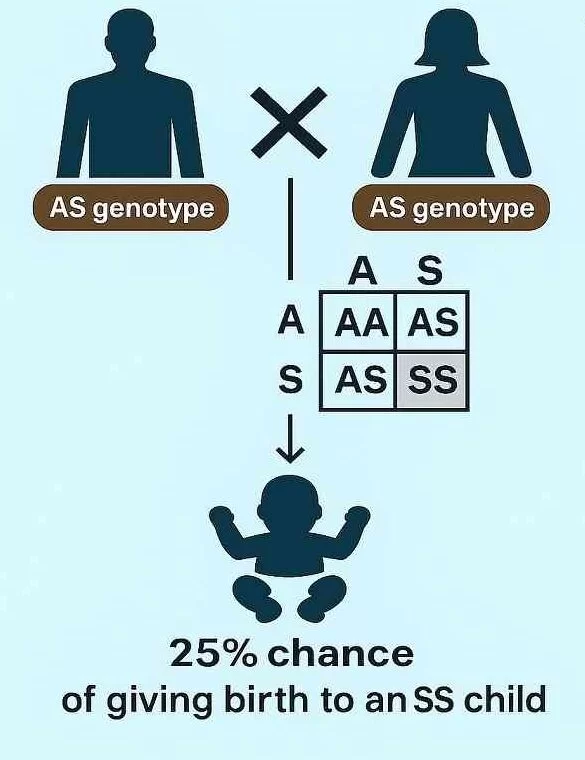
This puts the child at a lifelong risk of chronic anemia, repeated severe pain crises, and poor growth, which can significantly affect the child’s quality of life.
While you may think that a 25% risk is a manageable risk, it’s far worse than that. Rather than being a 1 in 4 probability of having an SS child, it actually means 1 in 4 chances of each pregnancy ending up with a child with sickle cell disease. This means that it is possible to have multiple children, or all children with SS, making it a costly risk to take.
In addition, even if it were only one child affected, this outcome can still carry a significant financial and psychosocial burden for the entire family. While the parents are worried about the next crisis and its outcome, the child is scared of the painful experience each time. Sickle cell disease can also largely determine what the child can or cannot do with his or her life.
To know that all of these are preventable is a good thing, but many people are still unaware or pay too little attention to this life-determining decision. Hence, this article shows everyone clear reasons why AS + AS should not marry, even if, technically, they can.
Which Genotype Combinations Are Safe for Marriage?
Again, genotype does not directly affect physical and romantic affection, but it is important to consider the risks before deciding to marry. Safe genotype combinations are those that do not have any chance of producing a child with genotypes SS, CC, or SC, and include the following.
- AA + AA ✅
- AA + AS ✅
- AA + SS ✅
- AA + AC ✅
Genotype Combinations to Avoid
Genotypes that carry any risk of producing the SS or CC pairs should be avoided, no matter how small the chances are. The following combinations are medically advised not to marry.
- AS + AS ❌
- AS + SS ❌
- AC + AC ❌
- AC + CC ❌
- AS + AC ❌
- AC + SS ❌
- SS + SS ❌
Genotypes CC and SC often have milder symptoms than genotype SS, but they are also classified as sickle-cell disease genotypes that should be avoided.
Can I Marry Someone With Sickle Cell?
When asked plainly, “Can I marry someone with sickle cell?” or “Can I marry a sickle cell woman?”, the answer depends on your genotype and which genotype your partner has. A sickle cell trait (AS) differs from sickle cell disease (SS) in the number of sickle cell genes(S) each contains.
If your partner has genotype AS (sickle cell trait), the same 25% risk calculation applies if you also have AS. If your partner has genotype SS (sickle cell disease), the risk is even higher. See the “Genotype Combinations to Avoid” table above for the full picture.
However, if you are genotype AA, you can marry a sickle cell carrier (someone with the sickle cell trait AS) or a sickle cell disease (SS) individual. This is because in the absence of the S gene, there is zero risk of having children with the feared SS genotype (or sickle cell disease).
The only reliable way to answer this question for your specific situation is by knowing your own and your partner’s genotype through a blood test (covered later in this article).
What is Sickle-Cell Disease?
Sickle-cell disease or sickle-cell anaemia is a group of inherited disorders that affect hemoglobin, the major protein that carries oxygen in red blood cells.2National Heart, Lung, and Blood Institute. (2023). Sickle Cell Disease. U.S. Department of Health and Human Services. Retrieved from https://www.nhlbi.nih.gov/health/sickle-cell-disease. This abnormality results from the inheritance of two homozygous sickle cell genes (S), which causes normal disc-shaped red blood cells to form a sickle shape when blood oxygen levels are low, even slightly.
Red blood cells with normal hemoglobin remain disc-shaped under all oxygen conditions, allowing them to navigate through the blood vessels easily and absorb enough oxygen to meet the body’s metabolic demands. In contrast, red cells with the sickle cell hemoglobin form a crescent or sickle shape that can get trapped in tiny blood vessels and carry less oxygen throughout the body.
Trapping of sickled red blood cells can further block blood flow and oxygen supply to organs and tissues, resulting in severe, painful crises typically seen in sickle cell disease. Also, fluctuating levels of oxygen in the blood can cause repeated cycles of sickling and unsickling, which weakens the red cell membrane and causes chronic hemolysis. This leads to a chronic anemic state, and is why the disease is also referred to as sickle-cell anemia.
How To Know Your Genotype
It is possible to know your genotype before getting married or agreeing to marry. And this is recommended by health professionals.
To know your genotype, you can visit a health facility or laboratory where blood tests can be carried out using specialized equipment for the genotype test. The result typically comes out within a few minutes to hours.
For better results, it is recommended to do the test at a credible laboratory or repeat the test at two or more different laboratories to compare the results. Irrespective of where it is done, it should give the same consistent results if the equipment is functional and accurate.
Complications of Sickle-Cell Disease
Sickle cell disease has several complications for the child, the parents, and the entire family. Here are some common complications of sickle cell disease that are worthy of note.
- The affected child suffers from recurrent severe pain crisis
- Chronic anemia in the affected child can affect their general well-being
- Poor growth of the child due to chronic anemia
- Emotional and psychological problems resulting from chronic severe pain
- Increased cost of child care to parents
- Emotional trauma and guilt in parents, which can sometimes lead to separation or divorce
- Anxiety in siblings of affected child(ren)
How to Prevent Sickle Cell Disease in Children
If you are not yet married, the best way to prevent sickle cell disease is to avoid getting married to a partner with genotype AS, SS, SC, or CC when you have the same genotype. This can lead to the expression of the double homozygous genes that cause sickle cell disease.
1. Adoption
Adoption is the best and cheapest way to prevent sickle cell disease when married to a partner with an incompatible genotype combination. It is a legal process of getting a child or children without giving birth to them biologically.
Usually, during the process of adoption, the children’s genotype would already have been checked by the adoption agency, giving you the chance to know their genotype before taking him/her in.
While it is still possible to intentionally adopt a child with sickle cell disease, you are often free from guilt, and you can first make sure you are financially capable of caring for the child.
To further consolidate your decision to prevent the risk of having a child with sickle cell disease, consider an effective contraceptive option like barrier contraceptives or permanent contraception methods like tubal ligation (for women) or vasectomy (for men). Tubal ligation involves a minimally invasive procedure where a woman’s fallopian tube is tied and cut to prevent pregnancy, while vasectomy is the analogue in men, where the vas deferens is tied and cut.
2. In Vitro Fertilization
In vitro fertilization (IVF) is a procedure that involves ovarian stimulation, ova acquisition and selection, and pre-implantation genetic testing for monogenic disorders (PGT-M). One or more mature ova (eggs) are obtained from the mother and fertilized with sperm from the father in a controlled environment. They are then fertilized in a glass tube, hence the name in vitro fertilization.
PGT-M is then carried out to test for chromosomal defects such as cystic fibrosis, Huntington’s disease, and sickle cell disorders like HbSS, α, and β-thalassemias. After this, one or more viable embryo(s) are reimplanted into the mother’s womb, and the pregnancy is then delivered at term.3Genomix Nigeria. Genotype. Retrieved July 16, 2025, from https://genomix.ng/category/genotype/
Sperm selection is an adjunct procedure where sperm are screened for the S or C gene before being used to fertilize the ovum. Sperm can have A, S, or C, but not two or all three alleles. Thus, by genetically selecting sperm with the A allele, they can eliminate the chances of producing a baby with sickle cell disease.
The drawback of these procedures is that they are expensive. The average cost of IVF is between $1,200 and $12,000 (price adjusted to all countries). In addition, a failed implantation or IVF pregnancy means a repeat procedure and a second payment altogether.
3. Surrogacy
Surrogacy is the third way couples with incompatible genotypes can have children who do not have sickle cell disease. It’s quite challenging because it involves a man having children with another woman (a surrogate) who is genetically compatible.
There are two types of surrogacy–traditional surrogacy and gestational surrogacy.
In traditional surrogacy, sperm is obtained from the man and inserted into a pre-agreed surrogate mother who has genotype AA, a process known as artificial insemination. Then, the sperm fertilizes the woman’s ovum via the normal biological process, and the woman carries the pregnancy until delivery at term (9 months).4Southern Surrogacy. Gestational vs. traditional surrogacy. Retrieved July 16, 2025, from https://www.southernsurrogacy.com/surrogacy-information/gestational-vs-traditional-surrogacy/
On the other hand, gestational surrogacy involves using the gametes (sperm and egg) from both true parents who are married to each other. The gametes are fertilized in the test tube, selected, and transferred into the surrogate mother who carries the pregnancy to term. This type is more commonly used when the true mother does not have an adequate womb (uterus) capable of carrying a baby to term, while traditional surrogacy is preferred for genotype-related cases.
One major challenge with surrogacy is that a breach of surrogacy contracts could lead to conflicts regarding the child’s ownership after birth. In addition, there may be a degree of lack of emotional connection between the true mother and the child born via surrogacy.
Can Sickle Cell Disease Be Cured?
Sickle cell disease can now be cured through bone marrow (stem cell) transplant (BMT), a procedure where defective blood-producing cells in the bone marrow are replaced with healthy ones from a compatible donor.
While BMT is widely recognized as the cure for sickle cell disease, the procedure is not commonly done due to its high cost, limited availability, and potential complications. Some possible complications include graft-versus-host disease (GVHD), severe bone marrow infections, graft rejection, and a high incidence of neurologic issues like seizures or hemorrhages.
Due to this, prevention through pre-marital genotype compatibility testing and genetic counseling remains the most practical approach.
Final words
Two people with an AS genotype can marry, but this carries a significant risk of having a child or children with sickle cell disease. Due to this, health professionals advise such couples not to marry.
The challenges of sickle cell disease are far-reaching. Though there is a new treatment procedure, it is better to prevent it through genetic compatibility testing and adequate counseling before marriage.
Making decisions about genotype compatibility is not always easy, which is why it is important to understand the risks. If you found this article helpful, share it with someone who might also benefit from it, and feel free to share your thoughts or questions in the comments below.
References
| ↑1 | Adegoke, S. A., & Kuteyi, E. A. (2012). Psychosocial burden of sickle cell disease on the family, Nigeria. African Journal of Primary Health Care & Family Medicine, 4(1), 380. https://doi.org/10.4102/phcfm.v4i1.380 |
|---|---|
| ↑2 | National Heart, Lung, and Blood Institute. (2023). Sickle Cell Disease. U.S. Department of Health and Human Services. Retrieved from https://www.nhlbi.nih.gov/health/sickle-cell-disease |
| ↑3 | Genomix Nigeria. Genotype. Retrieved July 16, 2025, from https://genomix.ng/category/genotype/ |
| ↑4 | Southern Surrogacy. Gestational vs. traditional surrogacy. Retrieved July 16, 2025, from https://www.southernsurrogacy.com/surrogacy-information/gestational-vs-traditional-surrogacy/ |













You Might Also Like