
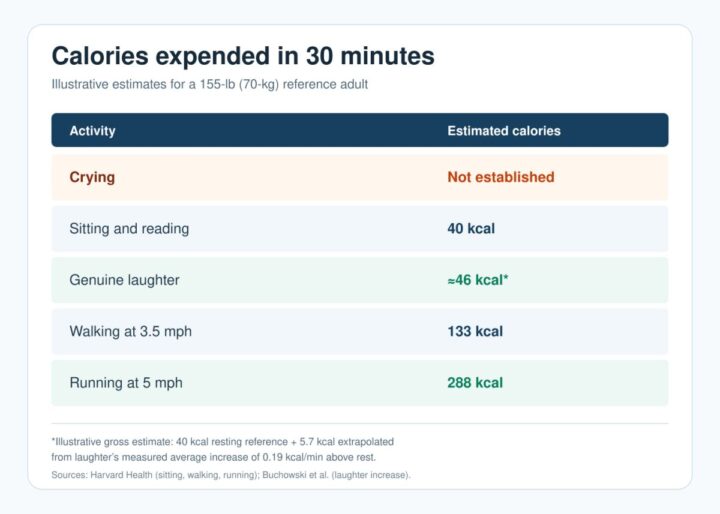
Yes, crying burns calories because your body continues to use energy even at rest. Based on the standard reference value of 1 MET, a 70 kg adult expends approximately 1.2 calories per minute, or 35 calories over 30 minutes, while sitting. Quiet crying may expend a similar amount, but no reliable study has established whether it burns additional calories compared to the normal resting state.1Herrmann, S. D., Willis, E. A., Ainsworth, B. E., Barreira, T. V., Hastert, M., Kracht, C. L., Schuna, J. M., Jr., Cai, Z., Quan, M., Tudor-Locke, C., Whitt-Glover, M. C., & Jacobs, D. R., Jr. (2024). 2024 Adult Compendium of Physical Activities: A third update of the energy costs of human activities. Journal of Sport and Health Science, 13(1), 6–12. https://doi.org/10.1016/j.jshs.2023.10.010
A frequently cited online source stated that crying is thought to consume around 1.3 calories per minute, which is approximately 39 calories in 30 minutes, and 78 calories per hour. However, this value was extrapolated from research on laughter rather than a direct study on crying.2Buchowski MS, Majchrzak KM, Blomquist K, Chen KY, Byrne DW, Bachorowski JA. Energy expenditure of genuine laughter. Int J Obes (Lond). 2007 Jan;31(1):131-7. doi: 10.1038/sj.ijo.0803353. Epub 2006 May 2. Erratum in: Int J Obes (Lond). 2014 Dec;38(12):1582. PMID: 16652129; PMCID: PMC3518926. While laughter and crying have physiologic similarities, no reliable studies have been done to measure how many calories crying burns.
In this article, we will explore the amount of calories crying burns and how that occurs.
How Many Calories Does Crying Burn?
Crying is thought to expend almost the same energy as the resting energy expenditure, which is approximately 1 MET (Metabolic Equivalent). 1 MET is approximately equal to 1 kcal/kg/hour, which is equivalent to 1.2 calories per minute for a 70 kg adult sitting quietly.
Intense sobbing may burn slightly more calories due to additional muscular and respiratory activity involved. However, the exact amount of calories for both quiet crying and intense sobbing is unknown.
| Body weight | Estimate resting expenditure at 1 MET |
|---|---|
| 50 kg | 0.83 kcal/min |
| 60 kg | 1.00 kcal/min |
| 70 kg | 1.17 kcal/min |
| 80 kg | 1.33 kcal/min |
| 90 kg | 1.50 kcal/min |
These are standardized estimates based on 1 MET equalling approximately 1 kcal/kg/hour. Individual resting expenditure varies.
Where Did the “1.3 Calories per Minute” Claim Come From?
Several online articles, including Healthline, state that crying is thought to burn approximately 1.3 calories per minute. However, this figure did not come from a study on crying. The cited research examined the “energy expenditure of genuine laughter”, not crying.
In the cited study3Buchowski MS, Majchrzak KM, Blomquist K, Chen KY, Byrne DW, Bachorowski JA. Energy expenditure of genuine laughter. Int J Obes (Lond). 2007 Jan;31(1):131-7. doi: 10.1038/sj.ijo.0803353. Epub 2006 May 2. Erratum in: Int J Obes (Lond). 2014 Dec;38(12):1582. PMID: 16652129; PMCID: PMC3518926., the amount of energy expended by laughter was reported as 0.19+/-0.31 kcal/min above resting expenditure. In other words, laughter produced a small average increase above the calories the participants were already burning at rest, with considerable variations. In addition, the researchers did not study crying or conclude that crying burns 1.3 calories per minute.
Intense crying and intense laughter share similar motor features such as facial muscle contraction, shoulder movement, torso flexion, repeated vocalizations, and sometimes tears.4Graziano MSA. The origin of smiling, laughing, and crying: The defensive mimic theory. Evol Hum Sci. 2022 Mar 3;4:e10. doi: 10.1017/ehs.2022.5. PMID: 37588928; PMCID: PMC10426066. This makes the laughter-crying comparison hypothetically plausible, but no available studies establish that both activities expend the same amount of energy.
Therefore, 1.3 calories per minute is an unverified estimate for crying, not a scientifically measured value from studies in adults.
How Does Crying Burn Calories?

The body continues to expend energy on essential functions such as breathing, circulation, temperature regulation, brain activity, and cellular processes. This is regardless of whether one is crying or just sitting. This background energy use is commonly described as resting energy expenditure. MET values provide a standardized way of comparing the energy cost of activities against resting expenditure.5INTEGRIS Health. (2023, April). What is BMR, and how can it help your weight loss journey? https://integrishealth.org/resources/on-your-health/2023/april/what-is-bmr
Crying can involve facial muscle activation, diaphragm and respiratory muscle movement, torso movement, and vocalization. These can contribute to energy expenditure in the body at that point in time. Sobbing, wailing, and repeated vocalization may require more energy than silent tear production.
Emotional distress experienced during crying, especially emotional crying (caused by intense emotions), may temporarily affect heart rate and rate of breathing, but its contribution to calorie expenditure during crying has not been quantified. Reflex crying occurs when irritants like dust and smoke induce tears in the eyes, and generally involves less vocalization and body movement than emotional sobbing.
Does Sobbing Burn More Calories Than Quiet Crying?
Probably, but the difference has not been directly measured. Sobbing involves more forceful breathing, vocalization, facial muscle contraction, and upper body movement than quiet crying. These additional movements would be expected to increase calorie expenditure, but no study has quantified this difference yet.
Does Crying Help You Lose Weight?
Crying is a sedentary or very-low-intensity activity; thus, it does not consume sufficient additional calories to produce meaningful weight loss in adults.
Vigorous sobbing may slightly increase energy expenditure through increased breathing activity and muscle movement, but this additional amount is also likely not enough to cause significant weight loss. Weight loss occurs when calorie expenditure exceeds calorie intake, and vice-versa.
Weight changes during prolonged grief or emotional distress are more likely related to changes in appetite, food intake, sleep, or altered physical activity than from crying alone. During grief, reduced food intake creates an energy deficit because the individual consumes fewer calories, not because crying burns a substantial number of calories.
Does Crying Burn Calories in Babies?

Babies burn calories when they cry in the same way adults do. Vigorous crying may also temporarily increase their energy expenditure above resting expenditure due to significant body movement, vocalization, and faster breathing.
Research shows that the normal resting energy expenditure in normal-weight neonates is 48.3 ± 6.1 kcal/kg/day. This varies with factors such as weight, gestational age at birth, nutrition, health, and activity (including the intensity or duration of crying).6Cai, W., Yu, L., Lu, C., Tang, Q., Wan, Y., & Chen, F. (2003). Normal value of resting energy expenditure in healthy neonates. Nutrition, 19(2), 133-136. https://doi.org/10.1016/S0899-9007(02)00929-2 However, the amount of energy lost when babies cry is not significant enough to affect the baby’s overall calorie balance.
Can Crying Cause Weight Loss in Babies?
A study on the impact of excessive crying on weight loss in babies showed that there is no significant link between excessive crying, feeding, and weight loss in babies. This study highlights that crying babies are more likely to replace the calories expended through interval feeding, as crying was accompanied by feeding approximately half of the time.7Worobey, J., Peña, J., Ramos, I., & Espinosa, C. (2012). Infant difficulty and early weight gain: Does fussing promote overfeeding? Maternal & Child Nutrition, 10(2), 295. https://doi.org/10.1111/j.1740-8709.2012.00410.x
Thus, if a baby is losing weight or not gaining weight as expected, it is likely due to poor feeding or low milk intake, underlying illness or infection, or digestive issues.
If an excessively crying baby is feeding poorly, showing signs of dehydration, losing weight, or failing to gain weight as expected, seek medical advice as there could be an underlying feeding or health problem.
Are There Health Benefits to Crying?
Crying may not burn enough calories to cause meaningful weight loss, but it may serve some important emotional and social functions. Visible tears can communicate distress and encourage comfort from others, which may benefit emotional well-being.8Harvard Health Publishing. (2021, March 1). Is crying good for you? https://www.health.harvard.edu/blog/is-crying-good-for-you-2021030122020
Some people also report feeling relieved after crying, although this does not mean that crying consistently improves mood in every person or situation.
Basal tears continuously lubricate the ocular surface, while reflex tears help wash away irritants such as dust and smoke. However, these are not necessarily related to emotional crying, which may also involve changes in breathing, facial muscle contractions, vocalization, and other body movements.
Frequently Asked Questions
How many calories does crying burn per minute?
No reliable study has established how many calories crying burns per minute in adults. The frequently quoted estimate of 1.3 calories per minute was obtained by extrapolating from laughter, not by directly measuring crying.
A study on the energy expenditure of laughter showed an average increase of approximately 0.19 calories per minute above rest, but this value cannot automatically be applied to crying.
How many calories does crying burn in one hour?
There is also no current reliable value for the number of calories crying expends per hour, but if this were to be measured, it may be affected by body weight, resting metabolic rate, and the intensity of the cry and body movements.
Is crying equivalent to exercise?
No. Crying is not equivalent to physical exercise because it does not engage the muscles and joints as exercise does. While it may consume a small amount of metabolic energy, it does not provide the cardiovascular and metabolic benefits of physical activity.
Does screaming or shouting burn calories?
Screaming, shouting, or yelling burn calories because in addition to the resting energy expenditure, they involve considerable muscle movements and vocalization. However, they do not burn enough additional calories to cause significant weight loss.
Can crying make you lose weight fast?
No, crying cannot cause rapid weight loss. Weight loss during emotional distress is usually due to reduced appetite or emotional stress rather than from crying.
Does emotional crying burn more calories than reflex crying?
Theoretically, emotional crying should burn more calories than reflex crying. This is because emotional crying may involve sobbing, increased breathing, and more muscle movement, whereas reflex crying is caused by the stimulation of tears by smoke, onions, or pollutants. However, no reliable study has directly compared their calorie expenditure.
Does crying burn calories if you are sitting still?
Yes. Your body continues to burn calories while you sit and cry. This energy your body consumes at rest is called basal metabolism, and it helps support breathing, circulation, brain activity, and other essential bodily functions. Moreover, crying may add a small amount to the total calorie loss through increased respiratory and muscular activity.
Final words
Crying burns calories, but most of this energy expenditure comes from the energy your body already uses at rest. Sobbing and increased body movement may temporarily increase energy use, but the additional amount has not been measured and is unlikely to produce noticeable weight loss.
The widely repeated estimate of 1.3 calories per minute was extrapolated from research on laughter and should not be treated as a confirmed crying statistic. At present, the most accurate conclusion is that crying uses energy, but how many additional calories it burns remains unknown.
References
| ↑1 | Herrmann, S. D., Willis, E. A., Ainsworth, B. E., Barreira, T. V., Hastert, M., Kracht, C. L., Schuna, J. M., Jr., Cai, Z., Quan, M., Tudor-Locke, C., Whitt-Glover, M. C., & Jacobs, D. R., Jr. (2024). 2024 Adult Compendium of Physical Activities: A third update of the energy costs of human activities. Journal of Sport and Health Science, 13(1), 6–12. https://doi.org/10.1016/j.jshs.2023.10.010 |
|---|---|
| ↑2, ↑3 | Buchowski MS, Majchrzak KM, Blomquist K, Chen KY, Byrne DW, Bachorowski JA. Energy expenditure of genuine laughter. Int J Obes (Lond). 2007 Jan;31(1):131-7. doi: 10.1038/sj.ijo.0803353. Epub 2006 May 2. Erratum in: Int J Obes (Lond). 2014 Dec;38(12):1582. PMID: 16652129; PMCID: PMC3518926. |
| ↑4 | Graziano MSA. The origin of smiling, laughing, and crying: The defensive mimic theory. Evol Hum Sci. 2022 Mar 3;4:e10. doi: 10.1017/ehs.2022.5. PMID: 37588928; PMCID: PMC10426066. |
| ↑5 | INTEGRIS Health. (2023, April). What is BMR, and how can it help your weight loss journey? https://integrishealth.org/resources/on-your-health/2023/april/what-is-bmr |
| ↑6 | Cai, W., Yu, L., Lu, C., Tang, Q., Wan, Y., & Chen, F. (2003). Normal value of resting energy expenditure in healthy neonates. Nutrition, 19(2), 133-136. https://doi.org/10.1016/S0899-9007(02)00929-2 |
| ↑7 | Worobey, J., Peña, J., Ramos, I., & Espinosa, C. (2012). Infant difficulty and early weight gain: Does fussing promote overfeeding? Maternal & Child Nutrition, 10(2), 295. https://doi.org/10.1111/j.1740-8709.2012.00410.x |
| ↑8 | Harvard Health Publishing. (2021, March 1). Is crying good for you? https://www.health.harvard.edu/blog/is-crying-good-for-you-2021030122020 |













You Might Also Like