
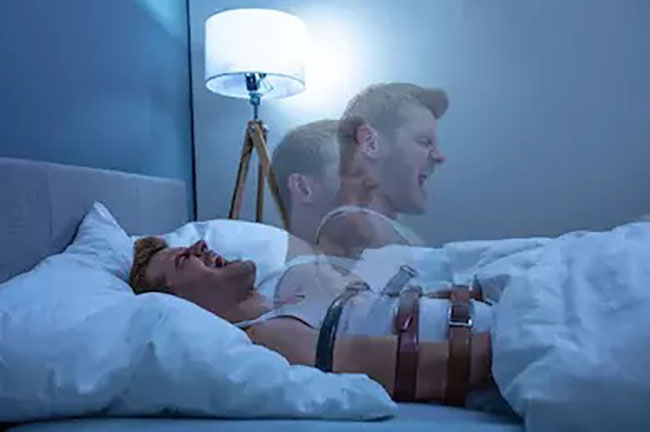
You woke up in the middle of the night, but were unable to move your body. You try to speak or scream, but nothing happens. Some people also get a feeling of chest tightness, or a perception of a shadowy figure standing in the room. If you’ve experienced these, that’s sleep paralysis.
Experiences like these can feel very terrifying, especially for those who have not heard of sleep paralysis. Many people fear they are having a medical emergency or a supernatural encounter. But while the situation can feel frightening, it’s usually harmless and temporary.
And while the first experience may be excused as just another bad dream, they may become more worried when they experience it several other times.
However, sleep paralysis is a relatively common phenomenon that occurs when the brain becomes conscious before the body wakes up from rapid eye movement (REM) sleep. Although the situation can feel frightening, it’s usually harmless and temporary.
In this article, we will learn more about sleep paralysis, its causes and triggers, and ways to prevent it naturally.
What is Sleep Paralysis?
Sleep paralysis (SP) can be defined as the early resumption of consciousness before one is fully awake. It is characterized by an inhibition of voluntary muscle movement (inability to move or speak) while breathing and eye movements are intact. And it occurs at the transition period when one is waking up or just falling asleep.1Ibid., Sharpless BA & Barbar JP, 20112Farooq M, Anjum F. Sleep Paralysis. Treasure Island (FL): StatPearls Publishing. 2025 Jan.
During sleep paralysis, the primary cortex responsible for muscle movement and speech is active, but the brainstem is not fully awake. In this state, your eyes may open, and you are conscious of your surroundings, but voluntary signals from the cortex are blocked by the brainstem before they are executed. This is known as REM atonia.3Bhalerao, V., Gotarkar, S., Vishwakarma, D., & Kanchan, S. (2024). Recent Insights Into Sleep Paralysis: Mechanisms and Management. Cureus, 16(7), e65413. https://doi.org/10.7759/cureus.65413
Sleep paralysis is, thus, a temporary paralysis during sleep due to a disconnect between the awakening of the brain cortex and the midbrain. It is not due to a psychiatric condition or a spiritual encounter, like many people like to believe.
What Causes Sleep Paralysis?
The exact cause of sleep paralysis is not known, but studies have shown a strong association with sleep deprivation and irregular sleep patterns. More recent studies have also highlighted risk factors like stress, anxiety, psychiatric disorders such as anxiety, post-traumatic stress disorder (PTSD), bipolar disorder, and sleep disorders like narcolepsy.4Ibid. Bhalerao, V., Gotarkar, S., Vishwakarma, D., & Kanchan, S. (2024). Recent Insights Into Sleep Paralysis: Mechanisms and Management. Cureus, 16(7), e65413. https://doi.org/10.7759/cureus.65413
Poor sleep hygiene behaviors, such as alcohol close to bedtime and stimulant drugs like caffeine, also share a link. One study also found that lying face up (in the supine position) is more associated with sleep paralysis than lying facing down or the side.5Cheyne J. A. (2002). Situational factors affecting sleep paralysis and associated hallucinations: position and timing effects. Journal of Sleep Research, 11(2), 169–177. https://doi.org/10.1046/j.1365-2869.2002.00297.x
Symptoms of Sleep Paralysis
Sleep paralysis may be associated with one or more of the following symptoms:
- Inability to move while feeling awake
- Visual hallucinations of shadowy figures resembling a familiar or unfamiliar person
- Lucid dreams of recent or distant memory
- Vibrations in your ears or your entire body
- Feeling of chest tightness or being pressed down by an external force
- Inability to speak aloud, even when you try to speak
- Fear or apprehension on waking up
- Insomnia due to a fear of re-experiencing it
How to Prevent Sleep Paralysis
Having seen the common risk factors for sleep paralysis, here are some ways to avoid experiencing sleep paralysis. As someone who has experienced it countless times, I can confirm that these definitely help prevent sleep paralysis and guarantee better sleep.
1. Adopt good sleep hygiene
Sleep hygiene refers to behavioral changes that can help you overcome insomnia and get better sleep. It involves adopting a good sleep routine, optimizing your sleep environment, and upholding bedtime routines that enhance sleep.
Sleep and wake at a specified time daily, sleep in a cool and comfortable environment, and avoid alcohol or caffeine too close to bedtime. Activities that disrupt your normal sleep-wake cycle have been associated with sleep paralysis.
2. Avoid intense mental tasks past your bedtime
Intense mental tasks after bedtime can excessively stimulate your brain when you should be sleeping. This alters how you fall asleep and impairs the transition from one stage of sleep to another, or to awakening.
Sleep paralysis occurs when transitioning from or to REM (Rapid eye movement) sleep. Being overly active after bedtime can cause REM atonia, which is primarily responsible for sleep paralysis.
3. Limit caffeine at bedtime
This is also part of the sleep hygiene tips for better sleep. Caffeine impairs sleep, alters the normal sleep routine, and may affect how the brain cycles from one sleep phase to another, leading to REM atonia and sleep paralysis.
4. Listen to soothing music
In my personal experience with sleep paralysis, this tip has worked every time. Calming music helps you fall asleep faster and more deeply. This prevents any part of your brain from waking up when it should remain asleep.
Listening to calming music works particularly when you have stayed past your normal bedtime and are already anticipating an episode of sleep paralysis. Theoretically, it works by decreasing electroencephalographic spike frequency and restoring normal brain activity rhythm during sleep and wake states.6Trimble M, Hesdorffer D. Music and the brain: the neuroscience of music and musical appreciation. BJPsych Int. 2017 May 1;14(2):28-31. doi: 10.1192/s2056474000001720. PMID: 29093933; PMCID: PMC5618809.
5. Avoid alcohol or drugs close to bedtime
This is another sleep hygiene tip that can naturally improve sleep quality. Alcohol causes sleep fragmentation, meaning it makes you wake up in the middle of the night. This increases your chances of experiencing sleep paralysis when trying to fall asleep again.
How to Stop Sleep Paralysis
There is no way to stop sleep paralysis as it happens. Understanding what exactly happens during sleep paralysis, especially in your waking life now, can help you stay calm during an episode.
You come out of an episode sooner if you consciously focus on making small body movements, like moving a finger. Also, it causes you less fright and distress when you focus on what you see during the episode, rather than leaving your brain to assume that it is perceiving strange figures.
If that doesn’t help, it is helpful to recognize that you are experiencing sleep paralysis and that it is a temporary experience. Trying to fight the experience while you sleep only makes it more frightening on waking up.
Treatment of Sleep Paralysis
There is no exact treatment for sleep paralysis, as it is not exactly a disease condition. Sleep paralysis results from a physiologic mismatch between cortical alertness and the brainstem’s temporary inactivity.
However, if it occurs too frequently despite adopting adequate sleep hygiene, you might need to see a physician to treat any underlying medical cause, like a sleep disorder, psychiatric condition, or chronic medical illness that affects your sleep.
How long does sleep paralysis last?
An episode of sleep paralysis typically lasts from a few seconds to one or two minutes. Rarely does it last beyond two minutes. However, the perceived duration is often longer than the actual duration.
How can I break out from a sleep paralysis episode?
The easiest way to come out of sleep paralysis is by staying calm and focusing on regular breathing. Focus on small muscle movement like fingers or toes, and remind yourself that this is just a temporary experience.
How can sleep paralysis be prevented?
Adopt healthy sleep hygiene, avoid sleep-disrupting lifestyle, and sleep in a calm, relaxing environment at bedtime.
What causes hallucinations during sleep paralysis?
Hallucinations during sleep paralysis are usually visual. These occur because your eyes may be open during the episode. So, your brain may misinterpret the objects as strange figures, a person, etc., or may link the perception to a near or distant memory.
Does sleep position affect sleep paralysis?
Yes, studies have shown that sleeping on your back (supine position) increases the likelihood of experiencing sleep paralysis, compared to the prone or sideways position. This may be related to arousability from sleep and better visibility to surrounding objects in the supine position.
Is sleep paralysis a spiritual encounter?
Sleep paralysis is not a spiritual encounter. People who do not know much about it may misinterpret it as such.
How common is sleep paralysis?
Sleep paralysis is a fairly common experience, even though it is largely underreported due to myths surrounding it. Aggregate studies show that 7.6% of people will experience at least one episode of sleep paralysis in their lifetime.7Sharpless BA, Barber JP. Lifetime prevalence rates of sleep paralysis: a systematic review. Sleep Med Rev. 2011
Final Words
Sleep paralysis is a temporary paralysis that occurs during sleep. It is often characterised by the inability to move and speak, a feeling of chest tightness, or hallucinations during sleep.
Sleep paralysis is neither a spiritual issue nor a mental disorder, but it may be associated with poor sleep habits, some psychiatric conditions, and sleep disorders.
Ever experienced sleep paralysis before? Let me know what your experience was in the comments below.
References
| ↑1 | Ibid., Sharpless BA & Barbar JP, 2011 |
|---|---|
| ↑2 | Farooq M, Anjum F. Sleep Paralysis. Treasure Island (FL): StatPearls Publishing. 2025 Jan. |
| ↑3 | Bhalerao, V., Gotarkar, S., Vishwakarma, D., & Kanchan, S. (2024). Recent Insights Into Sleep Paralysis: Mechanisms and Management. Cureus, 16(7), e65413. https://doi.org/10.7759/cureus.65413 |
| ↑4 | Ibid. Bhalerao, V., Gotarkar, S., Vishwakarma, D., & Kanchan, S. (2024). Recent Insights Into Sleep Paralysis: Mechanisms and Management. Cureus, 16(7), e65413. https://doi.org/10.7759/cureus.65413 |
| ↑5 | Cheyne J. A. (2002). Situational factors affecting sleep paralysis and associated hallucinations: position and timing effects. Journal of Sleep Research, 11(2), 169–177. https://doi.org/10.1046/j.1365-2869.2002.00297.x |
| ↑6 | Trimble M, Hesdorffer D. Music and the brain: the neuroscience of music and musical appreciation. BJPsych Int. 2017 May 1;14(2):28-31. doi: 10.1192/s2056474000001720. PMID: 29093933; PMCID: PMC5618809. |
| ↑7, ↑8 | Sharpless BA, Barber JP. Lifetime prevalence rates of sleep paralysis: a systematic review. Sleep Med Rev. 2011 |












You Might Also Like